Texas DMV Practice Mock Exam 1
All 30 questions from Mock Exam 1, with answers and explanations.
A mixed exam: 6 sign questions, 4 road diagrams and 20 questions on the rules of the road, including right of way, alcohol, drugs & distractions and speed & following distance.
These are the 30 questions from Mock Exam 1, original practice questions on signs and the rules of the road, checked against the Texas Driver Handbook. Read through them with Show answer, or take the exam online first with the answers hidden and see your score. No sign-in needed.
These are original practice questions, not actual DPS exam questions. Each links to the Texas Driver Handbook (DL-7) so you can check the rule. Questions were last reviewed in November 2026; read how we write and check them.
Question 1 · Sharing the Road
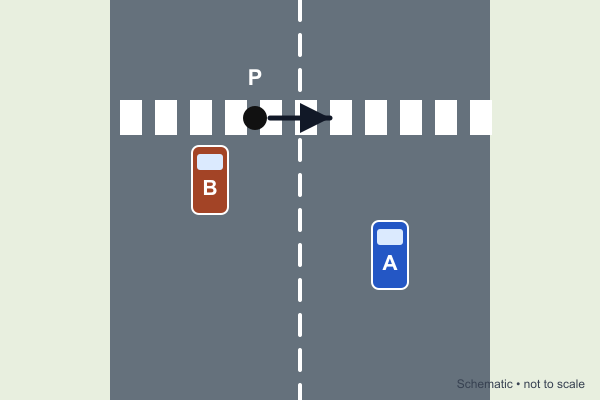
Car B is stopped for pedestrian P in the crosswalk. A approaches in the adjacent lane. What should A do?
- A. Pass B because P has not entered A's lane yet
- B. Accelerate before P arrives
- C. Drive around B on the sidewalk
- D. Stop as needed and do not pass B to overtake at the crosswalk
Show answer
Answer: D. Stop as needed and do not pass B to overtake at the crosswalk
A stopped vehicle can hide a crossing pedestrian. Never overtake a vehicle stopped to let a pedestrian cross.
Question 2 · Alcohol, Drugs & Distractions
You receive a text while driving and want to read it. What should you do?
- A. Read it while looking up between words
- B. Wait until safely parked to read it
- C. Hold the phone low to avoid distraction
- D. Ask the driver behind to watch traffic for you
Show answer
Answer: B. Wait until safely parked to read it
Texas law generally bans reading, writing, or sending electronic messages at the wheel, with limited exceptions. Park safely before using the phone.
Question 3 · Pavement Markings
Two solid white lines separate your lane from an adjacent lane. What should you do?
- A. Cross them whenever traffic is slow
- B. Stay in your current lane and do not cross them
- C. Use them as a two-way turn lane
- D. Drive between them
Show answer
Answer: B. Stay in your current lane and do not cross them
Double solid white lines prohibit crossing. Choose a legal place for a lane change.
Question 4 · Right of Way
An ambulance approaches from behind with its siren and emergency lights operating. What is the proper response when you are clear of an intersection?
- A. Pull toward the right edge and stop safely
- B. Drive faster to keep ahead of it
- C. Follow it through the next red light
- D. Stop abruptly in your travel lane
Show answer
Answer: A. Pull toward the right edge and stop safely
Move to the right edge and stop for an approaching emergency vehicle. Keep intersections clear.
Question 5 · Road Signs
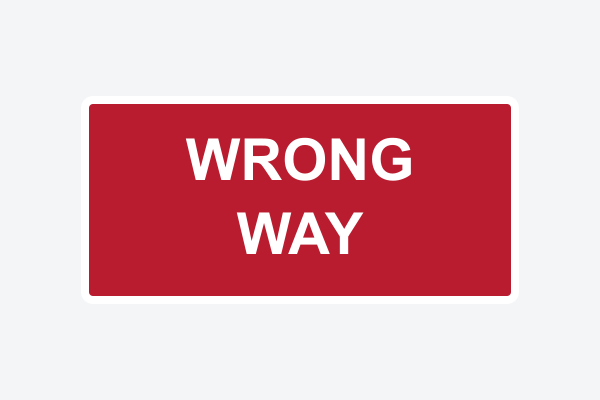
You face this sign after turning onto a roadway. What should you recognize?
- A. The road is closed only to trucks
- B. You are traveling against the permitted direction and must correct safely
- C. The sign warns only pedestrians
- D. You should speed up until the next exit
Show answer
Answer: B. You are traveling against the permitted direction and must correct safely
Wrong Way warns that you are moving against traffic. Avoid further exposure and correct the error safely.
Question 6 · Alcohol, Drugs & Distractions
A driver feels confident after drinking alcohol. What does that feeling prove about driving ability?
- A. Nothing; alcohol can impair judgment before the driver recognizes it
- B. The driver is safe on familiar roads
- C. The driver can compensate by opening a window
- D. The driver is safe if confident
Show answer
Answer: A. Nothing; alcohol can impair judgment before the driver recognizes it
Alcohol affects judgment and coordination. Subjective confidence does not establish fitness to drive.
Question 7 · Speed & Following Distance
Ahead, an emergency vehicle sits stopped with its lights on. Your side of the road has two lanes and the other lane is empty. What should you do?
- A. Stop in the travel lane next to it
- B. Accelerate past before it can pull out
- C. Stay beside it and sound the horn
- D. Change to the next lane over if you can do it safely
Show answer
Answer: D. Change to the next lane over if you can do it safely
For covered stopped vehicles, move out of the closest lane when possible on a multilane road. If unable to move safely, the required speed reduction applies.
Question 8 · Right of Way
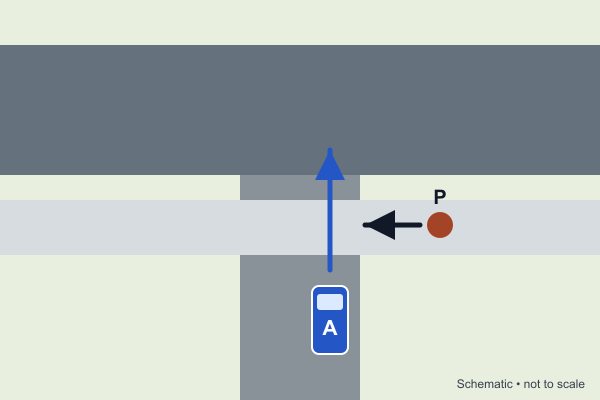
Car A is leaving a driveway across the sidewalk while pedestrian P approaches. What should A do?
- A. Stop and let P pass before crossing the sidewalk
- B. Drive on the sidewalk around P
- C. Assume the driveway gives A priority
- D. Pull across the sidewalk to make P stop
Show answer
Answer: A. Stop and let P pass before crossing the sidewalk
A driver leaving a driveway must give way to people on the sidewalk. The pedestrian path is shown in the diagram.
Question 9 · Teen License Rules
For the usual teen learner-license route, how old must you be to get a Texas learner license?
- A. 18 years old
- B. 13 years old
- C. 14 years old without exception
- D. 15 years old
Show answer
Answer: D. 15 years old
The usual learner-license route starts at age 15 and requires meeting the education and other eligibility requirements. Special hardship provisions are a separate route.
Question 10 · Road Signs
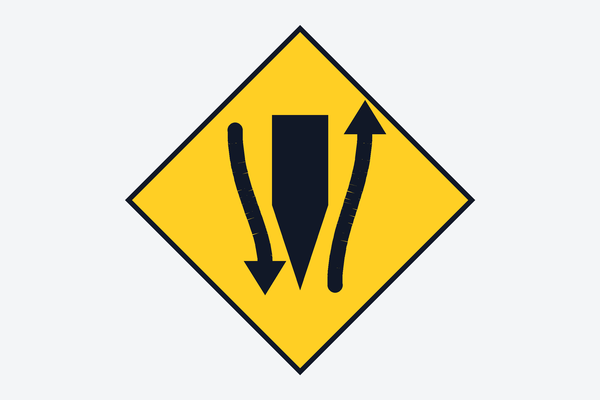
What roadway change does this symbol warn about?
- A. Opposing traffic will immediately share one lane
- B. A physical separation of opposing traffic begins
- C. A lane reserved only for motorcycles
- D. A bridge with a lower weight limit
Show answer
Answer: B. A physical separation of opposing traffic begins
The symbol warns of a divided highway beginning. Keep to the correct side of the divider.
Question 11 · Teen License Rules
A driver under 18 wants to make a hands-free social call while driving. No emergency exists. What is correct?
- A. The under-18 restriction also covers hands-free wireless use
- B. Calls are permitted below 30 mph
- C. Hands-free use is always permitted to minors
- D. Only texting is restricted for minors
Show answer
Answer: A. The under-18 restriction also covers hands-free wireless use
Texas restricts wireless communication device use by drivers under 18, including hands-free use, except emergencies.
Question 12 · Right of Way
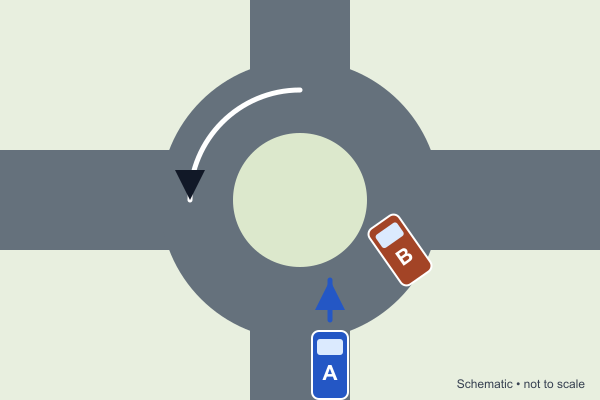
Car A is waiting to enter. Car B is already circulating in the roundabout. Which car must yield?
- A. B must stop for A at every entry
- B. A yields to B
- C. The car nearest the drawing's bottom goes first
- D. Neither must check the other
Show answer
Answer: B. A yields to B
Entering traffic yields to vehicles already circulating. Choose a gap without forcing B to brake.
Question 13 · Speed & Following Distance
On a dry road in good conditions at 45 mph, what minimum following time does the handbook recommend?
- A. 2 seconds
- B. 1 second
- C. 4 seconds
- D. The same distance as a parked car
Show answer
Answer: C. 4 seconds
Above 30 mph, maintain at least four seconds under good conditions and more when conditions worsen.
Question 14 · Speed & Following Distance
Heavy rain reduces visibility while you are driving below the posted maximum. What should determine your speed?
- A. The maximum alone, regardless of rain
- B. A speed safe for the actual conditions
- C. The speed of the fastest vehicle nearby
- D. A fixed speed above the limit to reduce time in rain
Show answer
Answer: B. A speed safe for the actual conditions
A posted maximum is not a guarantee that the speed is safe. Weather, visibility, traction, and traffic can require a lower speed.
Question 15 · Right of Way
Your light is green, but a pedestrian is lawfully crossing the street you intend to enter. What should you do?
- A. Yield and let the pedestrian cross safely
- B. Turn because green gives absolute priority
- C. Pass in front of the pedestrian if you can fit
- D. Honk until the pedestrian stops
Show answer
Answer: A. Yield and let the pedestrian cross safely
A green signal does not remove the duty to yield to pedestrians lawfully crossing.
Question 16 · Alcohol, Drugs & Distractions
An adult driver's BAC is below 0.08, but alcohol has caused loss of normal mental or physical faculties. Can DWI still apply?
- A. Only if there is a crash
- B. Only after midnight
- C. No, 0.08 is the only possible basis
- D. Yes, loss of normal faculties can establish intoxication
Show answer
Answer: D. Yes, loss of normal faculties can establish intoxication
Texas intoxication includes loss of normal mental or physical faculties from alcohol or other substances, as well as the per se alcohol concentration.
Question 17 · Road Signs
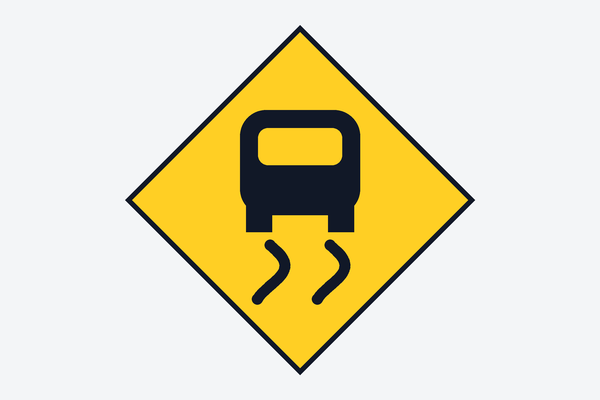
What risk does this warning symbol identify?
- A. Reduced traction when the roadway is wet
- B. A guarantee of flooding at every rain
- C. A mandatory lane change
- D. A road reserved for racing
Show answer
Answer: A. Reduced traction when the roadway is wet
The symbol warns that wet conditions can make the surface slippery. Use smooth controls and a suitable speed.
Question 18 · Alcohol, Drugs & Distractions
You notice repeated yawning and trouble keeping your lane. What is the best response?
- A. Follow another car closely to stay alert
- B. Stop at a safe place and rest
- C. Open a window and continue indefinitely
- D. Drive faster to arrive sooner
Show answer
Answer: B. Stop at a safe place and rest
Fatigue reduces attention and reaction ability. Rest is the proper response; noise or cold air does not replace sleep.
Question 19 · Parking
An accessible parking space is empty, but you have no qualifying plate or placard. May you use it for a quick errand?
- A. Yes, if the engine stays on
- B. Yes, for under five minutes
- C. No, it remains reserved for authorized users
- D. Yes, outside business hours
Show answer
Answer: C. No, it remains reserved for authorized users
An empty accessible space is not permission for an unauthorized vehicle to use it. Access aisles must also remain clear.
Question 20 · Road Signs
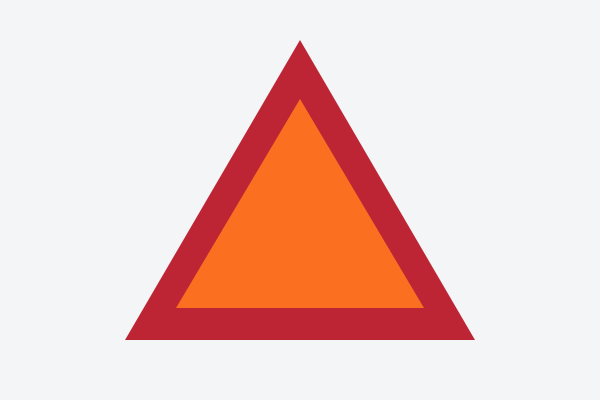
What does this reflective triangular emblem identify?
- A. A vehicle with emergency priority
- B. A slow-moving vehicle
- C. A vehicle that must travel in the passing lane
- D. A hazardous-materials container in every case
Show answer
Answer: B. A slow-moving vehicle
The orange triangle with a red border marks vehicles built to travel no faster than 25 mph. Approach with care.
Question 21 · Right of Way
You are leaving a store driveway and entering a public street. What must happen before you enter?
- A. Sound the horn and enter immediately
- B. Stop first, then give way to road traffic and people on the sidewalk
- C. Yield only to vehicles coming from the left
- D. Enter halfway so other drivers must stop
Show answer
Answer: B. Stop first, then give way to road traffic and people on the sidewalk
Coming out of a private drive, you stop before any sidewalk and let road traffic and pedestrians pass first.
Question 22 · Signaling, Passing & Turning
You realize too late that your turn is behind you. What should you do?
- A. Brake hard and reverse in the lane
- B. Cut across several lanes immediately
- C. Make a sudden turn from the wrong lane
- D. Continue to a safe legal place to change route
Show answer
Answer: D. Continue to a safe legal place to change route
A missed turn is less dangerous than an abrupt maneuver. Continue and reroute safely.
Question 23 · Signaling, Passing & Turning
You want to change lanes on a multilane road. Which sequence is safest?
- A. Check mirrors and blind spot, signal, and move only into a safe gap
- B. Signal and move immediately
- C. Look only in the inside mirror
- D. Rely on another driver's horn to reveal a vehicle
Show answer
Answer: A. Check mirrors and blind spot, signal, and move only into a safe gap
Mirrors have blind spots. A signal does not reserve a lane or replace a direct check.
Question 24 · Sharing the Road
A bicyclist ahead moves around broken pavement. How should you respond?
- A. Give the rider space and wait for a clear chance to pass
- B. Assume the rider must use the sidewalk
- C. Squeeze past in the same narrow space
- D. Honk continuously until the rider leaves the road
Show answer
Answer: A. Give the rider space and wait for a clear chance to pass
Bicyclists may need room to avoid hazards. Check surrounding traffic and give adequate space rather than crowding the rider.
Question 25 · Speed & Following Distance
On a dry road in good conditions at 25 mph, what minimum following time does the handbook recommend?
- A. 1 second
- B. No gap if traffic is light
- C. Half a second
- D. 2 seconds
Show answer
Answer: D. 2 seconds
At 30 mph or less on a good road, two seconds is the minimum gap. New drivers do better with four seconds, and any driver should add time when conditions get worse.
Question 26 · Road Signs
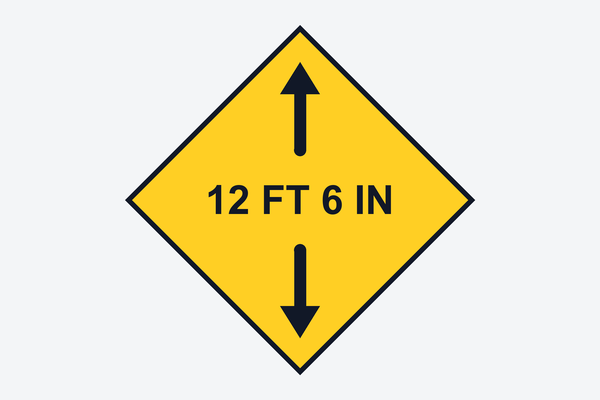
Your vehicle is taller than the clearance shown. What should you do?
- A. Lower tire pressure and continue without checking
- B. Do not proceed beneath the obstruction; choose a suitable route
- C. Assume the number is only a speed suggestion
- D. Drive through at higher speed
Show answer
Answer: B. Do not proceed beneath the obstruction; choose a suitable route
A low-clearance warning states available height. Know the vehicle's height and do not attempt an unsafe passage.
Question 27 · Road Signs
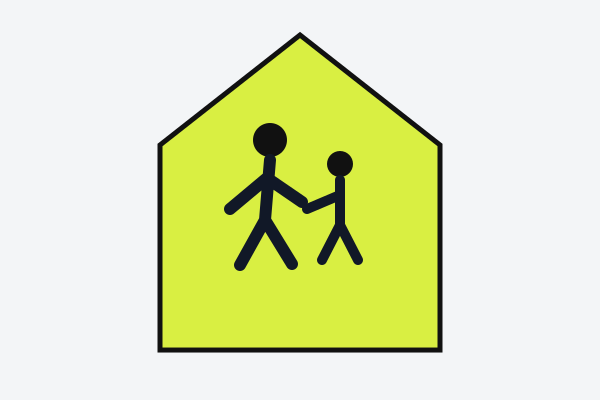
What area does this five-sided sign warn about?
- A. A railroad yard
- B. A school area or school crossing
- C. A hospital loading zone
- D. A truck-only intersection
Show answer
Answer: B. A school area or school crossing
Pentagon-shaped signs identify school areas and crossings. Watch carefully for children and obey posted controls.
Question 28 · Right of Way
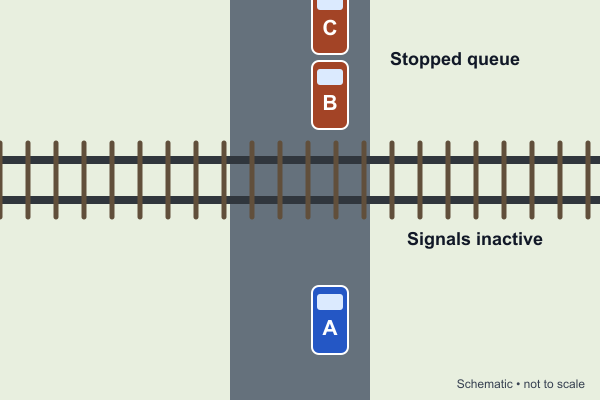
Traffic ahead is stopped, leaving too little room beyond the rails for car A. The crossing signals are not active. What should A do?
- A. Wait before the tracks until the whole car can clear
- B. Cross because no light is flashing
- C. Stop on the tracks behind the queue
- D. Follow the next car without checking space
Show answer
Answer: A. Wait before the tracks until the whole car can clear
Do not enter a rail crossing without room to clear it completely. Inactive signals are not a promise that a train will not arrive.
Question 29 · Parking
You park facing downhill beside a curb. Which way should you turn the front wheels?
- A. Straight ahead in every case
- B. Toward the curb
- C. Away from the curb
- D. Toward the center of the road
Show answer
Answer: B. Toward the curb
Turn downhill wheels toward the curb and set the parking brake so a rolling vehicle is directed away from moving traffic.
Question 30 · Crashes, Insurance & Safety Belts
Which set describes Texas minimum liability coverage amounts for bodily injury per person, bodily injury per crash, and property damage?
- A. $50,000 / $50,000 / $5,000
- B. $30,000 / $60,000 / $25,000
- C. $10,000 / $20,000 / $5,000
- D. $25,000 / $25,000 / $10,000
Show answer
Answer: B. $30,000 / $60,000 / $25,000
The minimum liability amounts are commonly described as 30/60/25. This is a legal minimum rather than a recommendation that it covers every loss.
Ready to test yourself?
Take a 30-question practice exam with the answers hidden. You get a score (pass with 21 of 30) and an explanation for every answer. For the real DPS exam, see about the permit test.
More free practice and lessons
- Free Texas DMV practice test
- Road signs practice test
- Rules of the road practice test
- Texas DMV Practice Mock Exam 2 with answers
- Texas DMV Practice Mock Exam 3 with answers
- Texas DMV Practice Mock Exam 4 with answers
- Texas DMV Practice Mock Exam 5 with answers
- Texas DMV Practice Mock Exam 6 with answers
- Texas DMV Practice Mock Exam 7 with answers
- Road signs by shape and color
- Right-of-way rules
- Numbers worth memorizing
- Texas rules for teen drivers
- About the Texas knowledge exam
- 7-day study plan
- Study tips