Texas DMV Practice Mock Exam 4
All 30 questions from Mock Exam 4, with answers and explanations.
A mixed exam: 6 sign questions, 4 road diagrams and 20 questions on the rules of the road, including alcohol, drugs & distractions, highway driving and parking.
These are the 30 questions from Mock Exam 4, original practice questions on signs and the rules of the road, checked against the Texas Driver Handbook. Read through them with Show answer, or take the exam online first with the answers hidden and see your score. No sign-in needed.
These are original practice questions, not actual DPS exam questions. Each links to the Texas Driver Handbook (DL-7) so you can check the rule. Questions were last reviewed in November 2026; read how we write and check them.
Question 1 · Sharing the Road
A vehicle is stopped before a crosswalk, hiding your view of people crossing. What should you do?
- A. Do not pass the stopped vehicle to overtake at the crosswalk
- B. Honk and accelerate around it
- C. Pass if you see no one in your lane yet
- D. Pass on the shoulder without slowing
Show answer
Answer: A. Do not pass the stopped vehicle to overtake at the crosswalk
A stopped vehicle may conceal a pedestrian. Passing a vehicle stopped to allow a pedestrian to cross is prohibited.
Question 2 · Road Signs
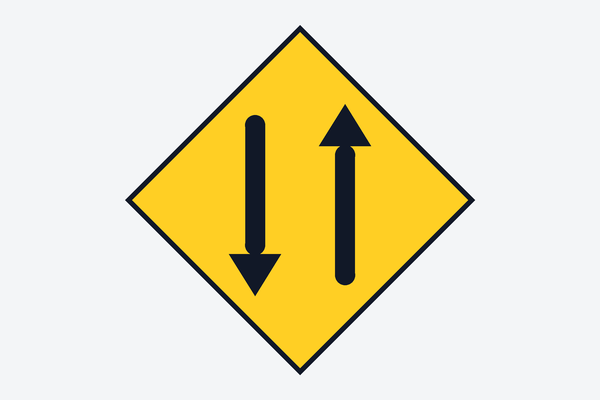
What change does this sign announce?
- A. A parking area ahead
- B. Two lanes moving only in your direction
- C. An express lane with no oncoming vehicles
- D. Opposing traffic ahead
Show answer
Answer: D. Opposing traffic ahead
Opposing arrows warn that you are entering or approaching a two-way roadway.
Question 3 · Parking
You are looking for parking near a railroad crossing. How far from the nearest rail must you stay?
- A. At least 5 feet
- B. At least 50 feet
- C. At least 10 feet
- D. At least 15 feet
Show answer
Answer: B. At least 50 feet
Keep a parked car 50 feet or more from the closest rail, so it never blocks a crossing or a driver's view of a train.
Question 4 · Alcohol, Drugs & Distractions
A person who has been drinking wants to drive after coffee and a cold shower. What actually reduces alcohol in the body over time?
- A. A cold shower immediately
- B. Driving with the windows open
- C. The body processing it over time
- D. Strong coffee immediately
Show answer
Answer: C. The body processing it over time
Coffee, showers, and fresh air do not remove alcohol from the bloodstream. Plan a sober ride.
Question 5 · Highway Driving
Your freeway exit has just passed. What should you do?
- A. Stop and back up in the right lane
- B. Reverse along the shoulder
- C. Continue to the next exit
- D. Turn across the median
Show answer
Answer: C. Continue to the next exit
Never back up on a freeway or cross its median to recover a missed exit. Continue to a safe legal route.
Question 6 · Sharing the Road
A bicyclist ahead extends the left arm straight out. What movement is being indicated?
- A. Permission for you to pass closely
- B. A stop only
- C. A right turn only
- D. A left turn
Show answer
Answer: D. A left turn
A left arm extended horizontally signals a left turn. Give the rider space to complete the movement.
Question 7 · Road Signs
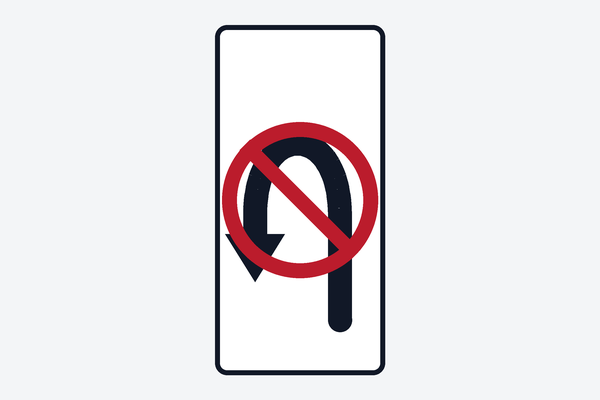
Which maneuver is prohibited here?
- A. Turning around to travel in the opposite direction
- B. Stopping at a red light
- C. Turning right after yielding
- D. Every left turn at every intersection
Show answer
Answer: A. Turning around to travel in the opposite direction
The U-shaped arrow with a prohibition mark means no U-turn. Other movements depend on their own controls.
Question 8 · Parking
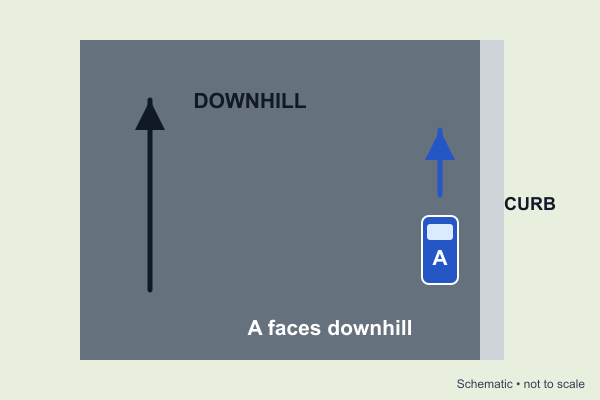
Car A is parked facing downhill beside the curb. Which wheel direction helps prevent a roll into traffic?
- A. Toward the curb
- B. Toward the centerline
- C. Away from the curb
- D. Straight along the road in every situation
Show answer
Answer: A. Toward the curb
Downhill parking calls for front wheels toward the curb, with the vehicle secured and parking brake set.
Question 9 · Night, Weather & Hazards
Water covers a low-water crossing, and you cannot judge its depth. What should you do?
- A. Enter slowly to measure the water
- B. Assume pavement markings prove it is safe
- C. Turn around and find another safe route
- D. Follow the largest vehicle through
Show answer
Answer: C. Turn around and find another safe route
Floodwater can hide damage and sweep vehicles away. Do not drive into water of unknown depth or around flood barriers.
Question 10 · Crashes, Insurance & Safety Belts
You strike an unattended parked car and cannot find its owner. What should you do?
- A. Leave because nobody saw it
- B. Wait briefly and then drive away without information
- C. Leave the required identifying information securely and fulfill applicable reporting duties
- D. Leave only a note saying sorry
Show answer
Answer: C. Leave the required identifying information securely and fulfill applicable reporting duties
Hitting an unattended vehicle still creates duties. Look for the owner, or leave your written details where they will be found.
Question 11 · Road Signs
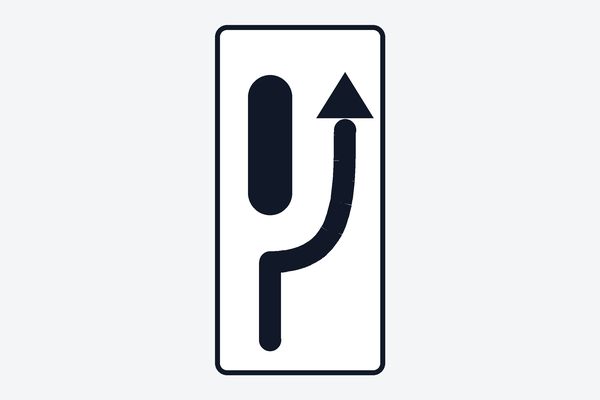
How should you pass the obstruction indicated by this sign?
- A. Stop beside the sign until waved on
- B. Drive left of the obstruction
- C. Pass on either side at will
- D. Keep to its right
Show answer
Answer: D. Keep to its right
The sign directs traffic around an island or obstruction on the indicated side.
Question 12 · Right of Way
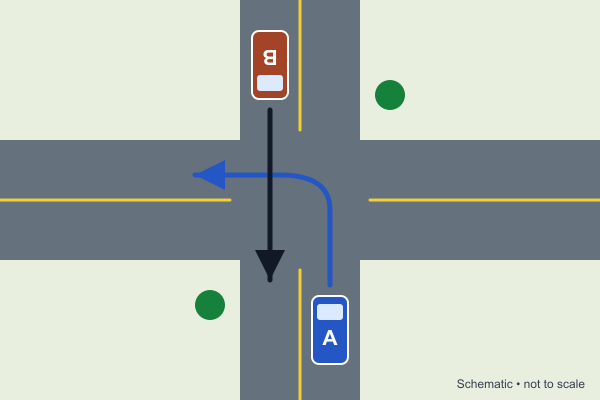
Car A is turning left across car B's straight path. Both face green signals without arrows. What should A do?
- A. Yield to B and wait for a safe gap
- B. Turn first because A is shown lower on the picture
- C. Turn because signaling gives priority
- D. Block B until it stops
Show answer
Answer: A. Yield to B and wait for a safe gap
An unprotected left turn yields to approaching traffic. Diagram position is not a source of priority.
Question 13 · Signaling, Passing & Turning
A car ahead is turning left. You could pass only by leaving the paved roadway. What should you do?
- A. Drive onto the sidewalk if empty
- B. Wait rather than drive off the pavement to pass
- C. Pass because the car has signaled
- D. Use the dirt shoulder at low speed
Show answer
Answer: B. Wait rather than drive off the pavement to pass
You may sometimes pass on the right, but never by driving off the pavement.
Question 14 · Alcohol, Drugs & Distractions
A prescription label warns that the medicine may cause drowsiness. What should you do before driving?
- A. Take extra medication to build tolerance
- B. Use coffee as a guaranteed antidote
- C. Assume prescriptions never impair driving
- D. Check its effects and follow medical advice about driving
Show answer
Answer: D. Check its effects and follow medical advice about driving
Prescription and nonprescription medicines can impair driving. Understand warnings and consult a clinician or pharmacist when needed.
Question 15 · Night, Weather & Hazards
You are following another vehicle within 300 feet at night. Which headlights should you use?
- A. Parking lights only
- B. Low beams
- C. High beams
- D. No lights if its taillights are visible
Show answer
Answer: B. Low beams
Use low beams when following within 300 feet. High beams can glare in the other driver's mirrors.
Question 16 · Highway Driving
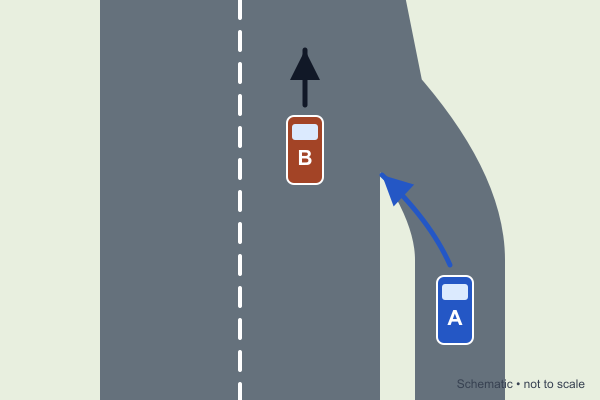
Car A is in the acceleration lane, and car B is on the highway. What is A's responsibility?
- A. Yield and merge into a safe gap
- B. Enter with no speed or mirror check
- C. Force B to stop
- D. Stop on the highway lane to join traffic
Show answer
Answer: A. Yield and merge into a safe gap
A is entering, so it gives way to through traffic and uses the acceleration lane to set up a safe merge.
Question 17 · Traffic Signals
After stopping at a steady red signal, you want to turn right. There is no sign prohibiting it. What else must you do?
- A. Wait for the driver behind to honk
- B. Yield to pedestrians and traffic before turning safely
- C. Enter the crosswalk to make pedestrians wait
- D. Turn immediately because you already stopped
Show answer
Answer: B. Yield to pedestrians and traffic before turning safely
A permitted right turn on red still requires a full stop and yielding. The absence of a prohibition does not make a gap safe.
Question 18 · Parking
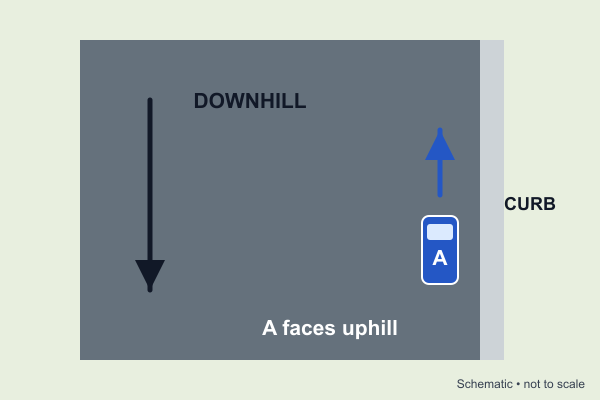
Car A is parked facing uphill beside the curb. Which wheel direction is correct?
- A. Toward the curb
- B. Either direction because a curb makes the brake unnecessary
- C. Straight only
- D. Away from the curb
Show answer
Answer: D. Away from the curb
When uphill beside a curb, turn wheels away from it so it can catch a backward roll. Also set the parking brake.
Question 19 · Crashes, Insurance & Safety Belts
A collision causes only vehicle damage, and both vehicles can be safely driven. What should the drivers do about the blocked lane?
- A. Keep the lane blocked until every detail is photographed
- B. Move to a suitable safe place and exchange required information
- C. Stand between the cars in moving traffic
- D. Leave the scene without exchanging details
Show answer
Answer: B. Move to a suitable safe place and exchange required information
Move drivable vehicles out of traffic when safe in a property-damage crash, then fulfill information and reporting duties.
Question 20 · Road Signs
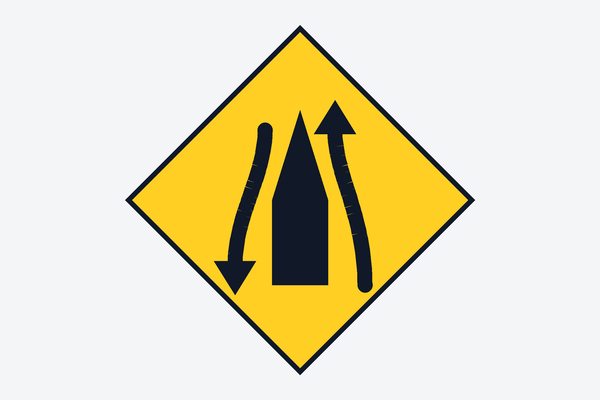
What should you prepare for after this sign?
- A. A permanent one-way road
- B. An immediate left turn across a median
- C. A new divider begins between directions
- D. The physical divider ends and opposing traffic may be closer
Show answer
Answer: D. The physical divider ends and opposing traffic may be closer
A divided-highway-ends sign warns that the separation ends. Watch lane markings and opposing traffic.
Question 21 · Right of Way
A school bus stops on the opposite roadway beyond a raised physical median. Its red lights flash. What does the divided roadway exception mean for you?
- A. You may ignore pedestrians on your roadway
- B. You need not stop solely for that bus but must remain alert
- C. Every vehicle on every roadway must stop
- D. The exception also applies to a painted center turn lane
Show answer
Answer: B. You need not stop solely for that bus but must remain alert
A driver on a separate roadway need not stop for the bus across the physical separation. A painted median or turn lane does not create that exception.
Question 22 · Road Signs
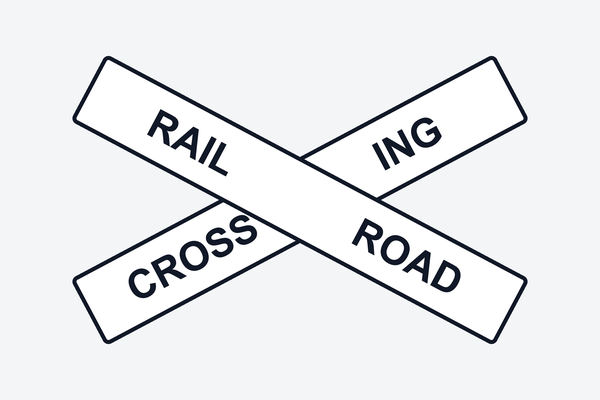
What does this crossbuck mark?
- A. A place to park clear of traffic
- B. An intersection where cars outrank trains
- C. A road open only to rail workers
- D. A railroad crossing where you must yield to trains
Show answer
Answer: D. A railroad crossing where you must yield to trains
A crossbuck marks a rail crossing. Trains cannot yield like cars; check for trains and obey signals.
Question 23 · Traffic Signals
You approach an intersection with a flashing red traffic signal. How should you treat it?
- A. As a stop sign
- B. As an uninterrupted green signal
- C. As a signal only for cross traffic
- D. As a warning to accelerate
Show answer
Answer: A. As a stop sign
A flashing red signal requires a stop, followed by yielding and proceeding when safe.
Question 24 · Signaling, Passing & Turning
Another driver is passing you on the left. How should you respond?
- A. Brake sharply without a hazard ahead
- B. Move left to discourage the pass
- C. Speed up to shorten the passing gap
- D. Keep right and avoid increasing speed
Show answer
Answer: D. Keep right and avoid increasing speed
Do not increase speed while being passed. Maintain safe positioning and help the pass finish safely.
Question 25 · Alcohol, Drugs & Distractions
A driver combines alcohol with a medicine that causes drowsiness. What is the concern?
- A. Only illegal drugs can worsen alcohol effects
- B. The medicine cancels the alcohol
- C. The combined impairment may be greater and unpredictable
- D. The combination is safe if each amount is small
Show answer
Answer: C. The combined impairment may be greater and unpredictable
Alcohol and other drugs can interact and increase impairment. Avoid driving when affected.
Question 26 · Sharing the Road
You cannot see a truck driver's face in the truck's side mirror. What should you assume?
- A. Your horn gives you priority
- B. You should stay beside the trailer
- C. The truck driver can always see your whole car
- D. You are probably in the driver's blind area
Show answer
Answer: D. You are probably in the driver's blind area
Large vehicles have extensive blind spots. Avoid lingering beside or close behind them.
Question 27 · Road Signs
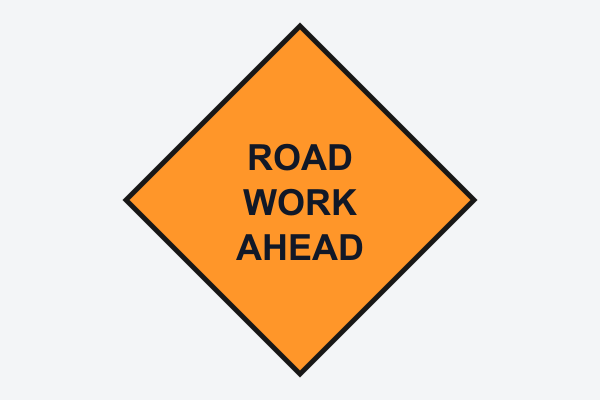
What should you anticipate after this orange diamond sign?
- A. An increase in the speed limit
- B. Road work and possible changes to lanes or traffic control
- C. A recreational area with no traffic rules
- D. A road reserved for bicycles
Show answer
Answer: B. Road work and possible changes to lanes or traffic control
Orange warning signs identify construction and maintenance conditions. Reduce speed as needed and follow directions.
Question 28 · Pavement Markings
A two-way road has a broken yellow centerline on your side. What does that line allow?
- A. Passing on a blind curve
- B. Passing when legal and safe with adequate sight distance
- C. Passing without checking opposing traffic
- D. Driving continuously in the opposing lane
Show answer
Answer: B. Passing when legal and safe with adequate sight distance
A dashed yellow line lets you cross to make a lawful pass, provided the way is clear. Sight distance and other limits still apply.
Question 29 · Highway Driving
You are using an entrance ramp to join highway traffic. What should you do?
- A. Force through traffic to brake for you
- B. Use the acceleration lane and yield while finding a safe gap
- C. Enter without checking the lane beside you
- D. Stop at the end of every ramp even with a clear gap
Show answer
Answer: B. Use the acceleration lane and yield while finding a safe gap
Build up to the speed of traffic where it is safe, and give way to cars on the highway. Do not assume they must make room.
Question 30 · Speed & Following Distance
A covered stopped emergency vehicle has flashing lights. You cannot safely move over, and the posted limit is 55 mph. What maximum speed satisfies the required reduction?
- A. 45 mph
- B. 55 mph
- C. 35 mph, or slower if needed for safety
- D. 50 mph
Show answer
Answer: C. 35 mph, or slower if needed for safety
If you cannot move over, drop to at least 20 mph under the posted limit wherever that limit is 25 mph or higher.
Ready to test yourself?
Take a 30-question practice exam with the answers hidden. You get a score (pass with 21 of 30) and an explanation for every answer. For the real DPS exam, see about the permit test.
More free practice and lessons
- Free Texas DMV practice test
- Road signs practice test
- Rules of the road practice test
- Texas DMV Practice Mock Exam 1 with answers
- Texas DMV Practice Mock Exam 2 with answers
- Texas DMV Practice Mock Exam 3 with answers
- Texas DMV Practice Mock Exam 5 with answers
- Texas DMV Practice Mock Exam 6 with answers
- Texas DMV Practice Mock Exam 7 with answers
- Road signs by shape and color
- Right-of-way rules
- Numbers worth memorizing
- Texas rules for teen drivers
- About the Texas knowledge exam
- 7-day study plan
- Study tips