Texas DMV Practice Mock Exam 3
All 30 questions from Mock Exam 3, with answers and explanations.
A mixed exam: 6 sign questions, 4 road diagrams and 20 questions on the rules of the road, including night, weather & hazards, parking and right of way.
These are the 30 questions from Mock Exam 3, original practice questions on signs and the rules of the road, checked against the Texas Driver Handbook. Read through them with Show answer, or take the exam online first with the answers hidden and see your score. No sign-in needed.
These are original practice questions, not actual DPS exam questions. Each links to the Texas Driver Handbook (DL-7) so you can check the rule. Questions were last reviewed in November 2026; read how we write and check them.
Question 1 · Pavement Markings
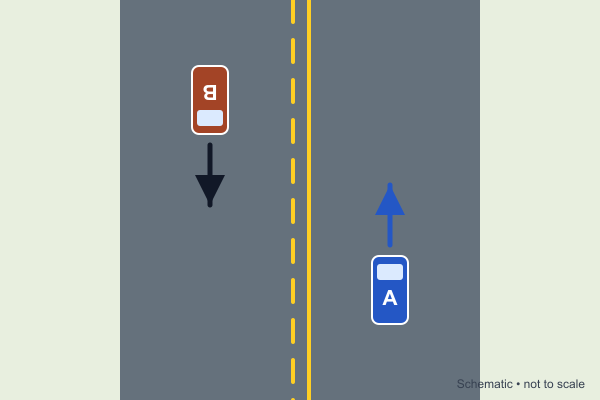
The center marking beside A is solid; the line beside B is broken. Which statement about passing across the center is correct?
- A. A may pass because B has a broken line
- B. Both may always pass
- C. Neither direction can ever pass anywhere on the road
- D. A may not cross the solid line to pass
Show answer
Answer: D. A may not cross the solid line to pass
The line closest to your lane decides whether you may pass. With a solid yellow line next to A, A may not cross it to pass.
Question 2 · Road Signs
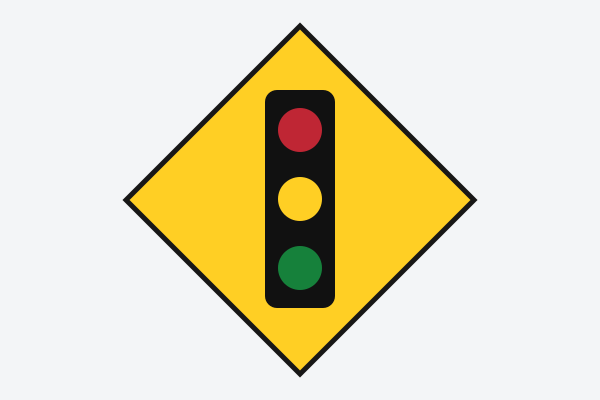
What should you expect beyond this warning sign?
- A. A road ending without an intersection
- B. A railroad gate only
- C. A traffic signal ahead
- D. An uncontrolled passing zone
Show answer
Answer: C. A traffic signal ahead
Signal Ahead warns you to prepare for a controlled intersection, including a possible need to stop.
Question 3 · Crashes, Insurance & Safety Belts
Your car has just been in a collision and someone is hurt. What should you do?
- A. Stop, summon appropriate help, and provide required information and reasonable aid
- B. Leave if the other driver seems at fault
- C. Move the injured person in every case
- D. Agree privately never to report it
Show answer
Answer: A. Stop, summon appropriate help, and provide required information and reasonable aid
Drivers involved in an injury crash must stop and fulfill legal duties, including obtaining help and providing information. Avoid unnecessary movement of injured people.
Question 4 · Parking
You park facing uphill beside a curb. Which way should you turn the front wheels?
- A. Away from the curb
- B. Straight ahead
- C. Toward the curb
- D. Toward the sidewalk only if the engine is running
Show answer
Answer: A. Away from the curb
With a curb, turn uphill wheels away from it so the curb can help stop a backward roll. Set the parking brake.
Question 5 · Night, Weather & Hazards
Your tires begin to lose contact with a wet road. What should you do first?
- A. Accelerate to press the tires down
- B. Ease off the accelerator and avoid abrupt braking or steering
- C. Apply the parking brake at once
- D. Brake sharply and turn hard
Show answer
Answer: B. Ease off the accelerator and avoid abrupt braking or steering
Gradual speed reduction and smooth control help restore traction. Sudden inputs can make loss of control worse.
Question 6 · Teen License Rules
A provisional-license driver under 18 wants to take two unrelated friends under 21. No exception applies. Is this allowed?
- A. Yes, whenever it is daylight
- B. Yes, if everyone wears a belt
- C. Yes, if the trip is less than a mile
- D. No, a provisional driver may carry only one non-relative under 21
Show answer
Answer: D. No, a provisional driver may carry only one non-relative under 21
Texas provisional restrictions limit passengers under 21 who are not family members to one. Seat belts do not remove the restriction.
Question 7 · Night, Weather & Hazards
Your right wheels drop onto a low shoulder. What should you do?
- A. Ease off, slow down, then steer back once it is safe to rejoin the pavement
- B. Accelerate sharply onto the road
- C. Brake hard while steering sharply
- D. Jerk the wheel left at once
Show answer
Answer: A. Ease off, slow down, then steer back once it is safe to rejoin the pavement
Avoid overcorrection. Regain control and reduce speed before carefully returning to the pavement.
Question 8 · Road Signs
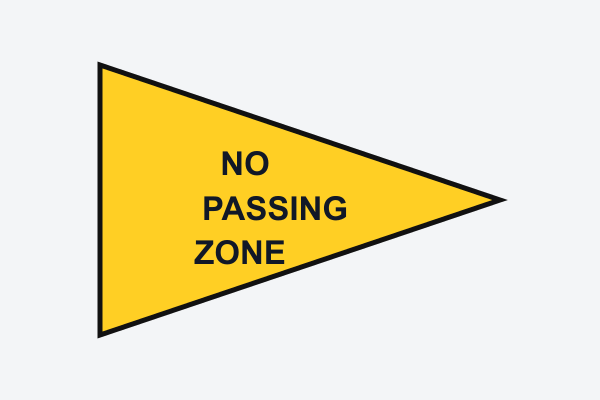
What restriction is announced by this pennant-shaped sign?
- A. A no-passing zone
- B. A minimum speed zone
- C. A mandatory passing lane
- D. A road reserved for buses
Show answer
Answer: A. A no-passing zone
A pennant warns of a no-passing zone. Do not begin a prohibited pass.
Question 9 · Speed & Following Distance
A covered stopped emergency vehicle has flashing lights. You cannot move over, and the posted limit is 20 mph. What maximum applies under the slow-down rule?
- A. 5 mph
- B. 10 mph
- C. 20 mph
- D. 15 mph
Show answer
Answer: A. 5 mph
When the posted limit is below 25 mph and a safe lane change is unavailable, the rule requires reducing speed to 5 mph.
Question 10 · Speed & Following Distance
You drive a passenger car in an urban district with no different limit posted. What general maximum applies?
- A. 45 mph
- B. 30 mph
- C. 70 mph
- D. 15 mph
Show answer
Answer: B. 30 mph
The general urban district limit is 30 mph unless a different lawful limit is posted. Conditions may require slower driving.
Question 11 · Night, Weather & Hazards
At night, an oncoming car is now closer than 500 feet. What should you do with your high beams?
- A. Keep high beams on until it passes
- B. Switch to low beams
- C. Turn off all lights
- D. Flash high beams continuously
Show answer
Answer: B. Switch to low beams
Drop to low beams once oncoming traffic is closer than 500 feet, so you do not dazzle the other driver.
Question 12 · Parking
You want to park near a fire hydrant. What minimum clearance is required?
- A. 3 feet
- B. 15 feet
- C. 8 feet
- D. 5 feet
Show answer
Answer: B. 15 feet
Hydrants need a 15-foot clear zone around them. Firefighters need access even when a space looks convenient.
Question 13 · Sharing the Road
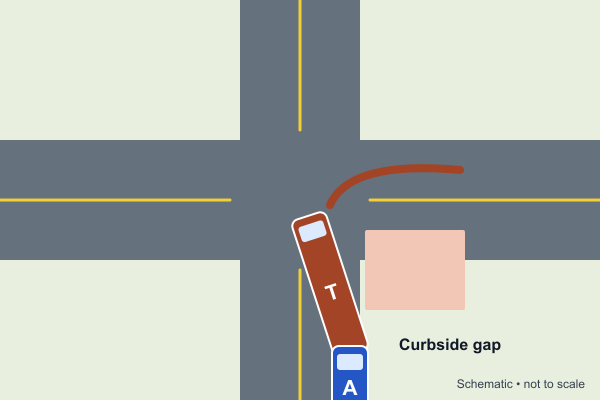
Truck T is making a wide right turn. Car A is behind it near the curb. What should A do?
- A. Stay behind and out of the curbside gap
- B. Assume the gap is a new traffic lane
- C. Pass between the truck and the curb
- D. Enter the gap beside the trailer
Show answer
Answer: A. Stay behind and out of the curbside gap
The rear wheels track inside the truck's front path. The curbside gap can close during the turn.
Question 14 · Road Signs
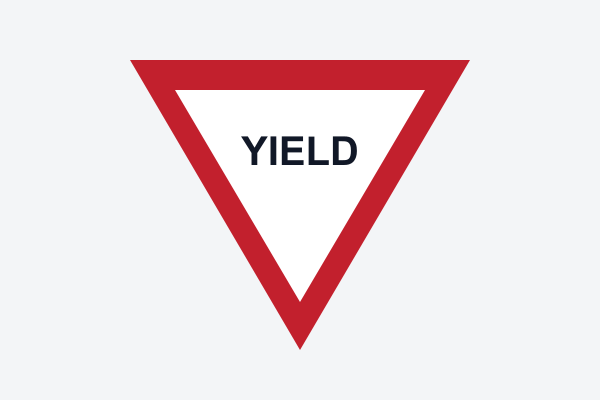
What does the pictured sign tell an approaching driver to do?
- A. Always go first
- B. Accelerate into the gap
- C. Slow and yield, stopping if necessary
- D. Stop and wait for a green light
Show answer
Answer: C. Slow and yield, stopping if necessary
A yield sign requires giving way to traffic with priority. Stop when needed for safety.
Question 15 · Night, Weather & Hazards
Daytime weather makes vehicles indistinct beyond 700 feet. What does the visibility rule require?
- A. Turn on headlights because visibility is less than 1,000 feet
- B. Use headlights only after sunset
- C. Use only hazard lights while moving
- D. Wait until visibility falls below 50 feet
Show answer
Answer: A. Turn on headlights because visibility is less than 1,000 feet
Headlights are required any time you cannot clearly make out people or vehicles 1,000 feet ahead, day or night.
Question 16 · Traffic Signals
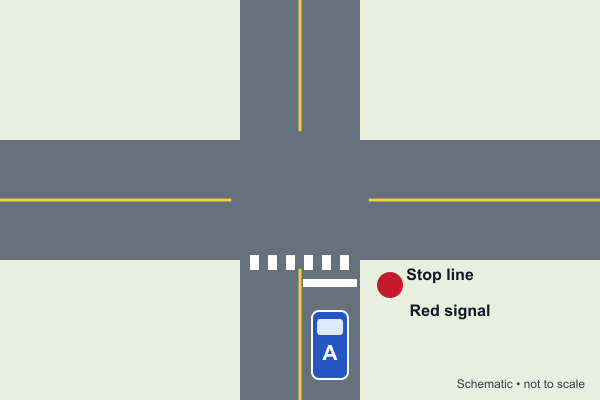
Car A approaches the red signal and marked stop line. Where must it stop?
- A. Beyond the crosswalk beside the signal
- B. In the center of the intersection
- C. On the crosswalk
- D. Behind the stop line
Show answer
Answer: D. Behind the stop line
The stop line marks the required stopping position. Keep the crosswalk clear.
Question 17 · Crashes, Insurance & Safety Belts
An adult passenger rides in the rear seat of a passenger car equipped with belts. What is required?
- A. Belts are required only in front
- B. Belts are optional on short trips
- C. The passenger must wear the safety belt
- D. Belts are unnecessary below 40 mph
Show answer
Answer: C. The passenger must wear the safety belt
Texas safety belt requirements cover passengers in seats equipped with safety belts, including rear seats.
Question 18 · Road Signs
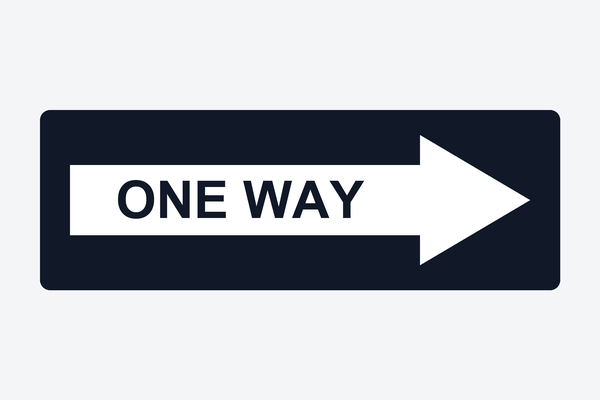
What does this sign establish?
- A. Traffic travels only in the arrow's direction
- B. The arrow marks a scenic detour
- C. Traffic may use either direction
- D. Only the left lane is open
Show answer
Answer: A. Traffic travels only in the arrow's direction
A One Way sign defines the lawful direction of traffic on that road.
Question 19 · Sharing the Road
A person with a white cane is crossing ahead of your vehicle. What should you do?
- A. Assume the person can see your signal
- B. Use the horn to demand the way
- C. Drive around at normal speed
- D. Yield and take precautions to avoid endangering the person
Show answer
Answer: D. Yield and take precautions to avoid endangering the person
Use special care around people with visual impairments. A white cane or guide dog signals the need for caution and yielding.
Question 20 · Road Signs
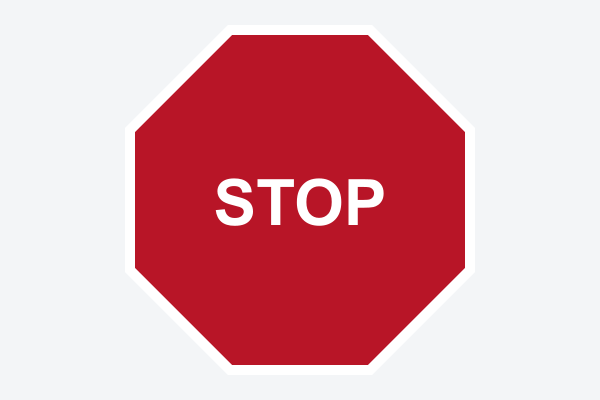
What action does the pictured sign require?
- A. Stop fully, then go when the way is clear
- B. Slow down without stopping
- C. Stop only when another car is visible
- D. Continue because the sign is a warning
Show answer
Answer: A. Stop fully, then go when the way is clear
The octagonal red stop sign requires a complete stop at the proper stopping position, then yielding before entry.
Question 21 · Signaling, Passing & Turning
You plan a turn on a public street. For at least how far before turning should you signal?
- A. 10 feet
- B. 100 feet
- C. Only while turning
- D. 25 feet
Show answer
Answer: B. 100 feet
Turn on your signal 100 feet or more ahead of the turn, early enough to communicate without misleading other drivers.
Question 22 · Pavement Markings
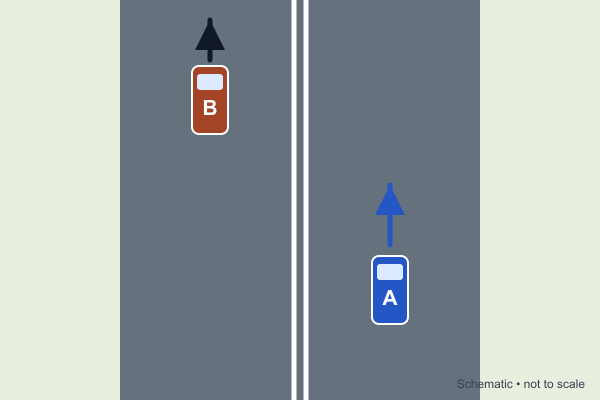
Car A wants to enter the adjacent lane across the two solid white lines shown. What should it do?
- A. Straddle both white lines
- B. Cross if the adjacent lane is faster
- C. Cross whenever its signal is on
- D. Wait for a legal crossing point
Show answer
Answer: D. Wait for a legal crossing point
Crossing double solid white lane markings is prohibited. A turn signal does not change that restriction.
Question 23 · Road Signs
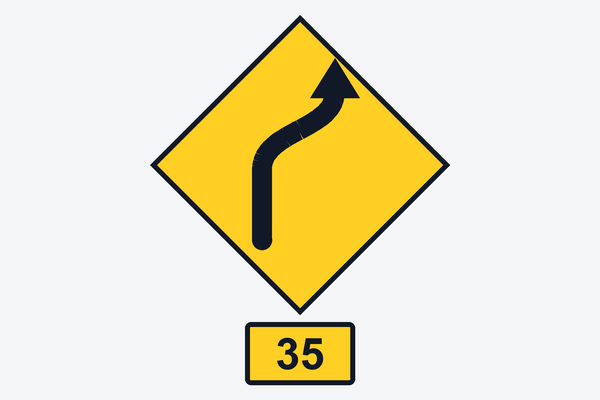
This curve warning has a smaller advisory speed plaque. What does the plaque convey?
- A. A guarantee that the curve is safe in ice
- B. Permission to exceed a posted regulatory maximum
- C. The minimum speed you must maintain
- D. A recommended speed for the curve under favorable conditions
Show answer
Answer: D. A recommended speed for the curve under favorable conditions
An advisory speed helps select a safe approach. Conditions may require slower speed and legal maximums still apply.
Question 24 · Teen License Rules
A Texas learner-license holder plans to practice driving. Who generally must accompany the learner in the front passenger seat?
- A. A qualified licensed driver at least 21 years old
- B. Any licensed driver at least 16 years old
- C. Nobody if the trip is short
- D. Any friend with a learner license
Show answer
Answer: A. A qualified licensed driver at least 21 years old
Learner driving requires qualified supervision by a licensed driver age 21 or older in the front seat, subject to the license restrictions.
Question 25 · Signaling, Passing & Turning
A shared center lane is marked for left turns in both directions. Which use is appropriate?
- A. Pass several slow vehicles
- B. Use it as an extra freeway entrance lane
- C. Prepare for a permitted left turn while watching for opposing users
- D. Travel in it until your destination is close
Show answer
Answer: C. Prepare for a permitted left turn while watching for opposing users
A two-way left-turn lane is for turning movements, not through travel or passing. Drivers from both directions may use it.
Question 26 · Right of Way
A crossing gate begins to descend while you approach the tracks. What should you do?
- A. Stop before the gate and wait
- B. Stop on the first rail to look
- C. Drive around the gate if no train is visible
- D. Race across before the gate closes
Show answer
Answer: A. Stop before the gate and wait
Never drive around or under a closing railroad gate. Cross only when signals and conditions permit.
Question 27 · Right of Way
You approach a roundabout with traffic already circulating. What should you do?
- A. Yield to circulating traffic and enter a safe gap
- B. Drive clockwise to shorten your route
- C. Stop inside the circle to choose an exit
- D. Enter first because arriving traffic has priority
Show answer
Answer: A. Yield to circulating traffic and enter a safe gap
Roundabout entrants yield to traffic already circulating. Follow lane markings and travel counterclockwise.
Question 28 · Parking
You are considering parking near an intersection crosswalk. What minimum clearance should you keep from that crosswalk?
- A. 20 feet
- B. 5 feet
- C. 10 feet
- D. 12 feet
Show answer
Answer: A. 20 feet
Parking is banned closer than 20 feet to a crosswalk at a corner, because parked cars there hide people crossing.
Question 29 · Right of Way
A school bus on the opposite side of an undivided road stops with red lights flashing. What must you do?
- A. Stop only if the bus driver waves
- B. Continue because the bus is across the centerline
- C. Pass slowly if no child is visible
- D. Stop until legally permitted to proceed
Show answer
Answer: D. Stop until legally permitted to proceed
Traffic in both directions stops for a school bus displaying its required stop signals on an undivided road. An ordinary centerline is not a physical separation.
Question 30 · Traffic Signals
The light changes to steady yellow while you can still stop safely before the intersection. What is the appropriate action?
- A. Accelerate to beat the red light
- B. Stop safely
- C. Stop in the middle of the intersection
- D. Sound the horn and continue at any speed
Show answer
Answer: B. Stop safely
Yellow means red is next. Stop if you can do it safely.
Ready to test yourself?
Take a 30-question practice exam with the answers hidden. You get a score (pass with 21 of 30) and an explanation for every answer. For the real DPS exam, see about the permit test.
More free practice and lessons
- Free Texas DMV practice test
- Road signs practice test
- Rules of the road practice test
- Texas DMV Practice Mock Exam 1 with answers
- Texas DMV Practice Mock Exam 2 with answers
- Texas DMV Practice Mock Exam 4 with answers
- Texas DMV Practice Mock Exam 5 with answers
- Texas DMV Practice Mock Exam 6 with answers
- Texas DMV Practice Mock Exam 7 with answers
- Road signs by shape and color
- Right-of-way rules
- Numbers worth memorizing
- Texas rules for teen drivers
- About the Texas knowledge exam
- 7-day study plan
- Study tips