Texas Rules of the Road Practice Test
Right-of-way, speed, parking, alcohol and license rules, with answers.
Most of the Texas knowledge exam is about driving safely and legally. These free questions cover right-of-way, speed and following distance, parking, sharing the road, alcohol and distractions, crashes and insurance, and Texas teen license rules. Tap Show answer to check each one. For the rules people most often get wrong, read our lessons on right-of-way and numbers worth memorizing.
These are original practice questions, not actual DPS exam questions. Each links to the Texas Driver Handbook (DL-7) so you can check the rule. Questions were last reviewed in November 2026; read how we write and check them.
Question 1 · Sharing the Road
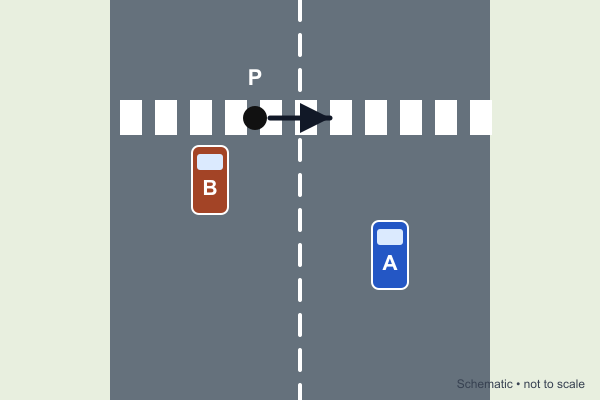
Car B is stopped for pedestrian P in the crosswalk. A approaches in the adjacent lane. What should A do?
- A. Pass B because P has not entered A's lane yet
- B. Accelerate before P arrives
- C. Drive around B on the sidewalk
- D. Stop as needed and do not pass B to overtake at the crosswalk
Show answer
Answer: D. Stop as needed and do not pass B to overtake at the crosswalk
A stopped vehicle can hide a crossing pedestrian. Never overtake a vehicle stopped to let a pedestrian cross.
Question 2 · Alcohol, Drugs & Distractions
You receive a text while driving and want to read it. What should you do?
- A. Read it while looking up between words
- B. Wait until safely parked to read it
- C. Hold the phone low to avoid distraction
- D. Ask the driver behind to watch traffic for you
Show answer
Answer: B. Wait until safely parked to read it
Texas law generally bans reading, writing, or sending electronic messages at the wheel, with limited exceptions. Park safely before using the phone.
Question 3 · Right of Way
An ambulance approaches from behind with its siren and emergency lights operating. What is the proper response when you are clear of an intersection?
- A. Pull toward the right edge and stop safely
- B. Drive faster to keep ahead of it
- C. Follow it through the next red light
- D. Stop abruptly in your travel lane
Show answer
Answer: A. Pull toward the right edge and stop safely
Move to the right edge and stop for an approaching emergency vehicle. Keep intersections clear.
Question 4 · Speed & Following Distance
Ahead, an emergency vehicle sits stopped with its lights on. Your side of the road has two lanes and the other lane is empty. What should you do?
- A. Stop in the travel lane next to it
- B. Accelerate past before it can pull out
- C. Stay beside it and sound the horn
- D. Change to the next lane over if you can do it safely
Show answer
Answer: D. Change to the next lane over if you can do it safely
For covered stopped vehicles, move out of the closest lane when possible on a multilane road. If unable to move safely, the required speed reduction applies.
Question 5 · Teen License Rules
For the usual teen learner-license route, how old must you be to get a Texas learner license?
- A. 18 years old
- B. 13 years old
- C. 14 years old without exception
- D. 15 years old
Show answer
Answer: D. 15 years old
The usual learner-license route starts at age 15 and requires meeting the education and other eligibility requirements. Special hardship provisions are a separate route.
Question 6 · Parking
An accessible parking space is empty, but you have no qualifying plate or placard. May you use it for a quick errand?
- A. Yes, if the engine stays on
- B. Yes, for under five minutes
- C. No, it remains reserved for authorized users
- D. Yes, outside business hours
Show answer
Answer: C. No, it remains reserved for authorized users
An empty accessible space is not permission for an unauthorized vehicle to use it. Access aisles must also remain clear.
Question 7 · Signaling, Passing & Turning
You realize too late that your turn is behind you. What should you do?
- A. Brake hard and reverse in the lane
- B. Cut across several lanes immediately
- C. Make a sudden turn from the wrong lane
- D. Continue to a safe legal place to change route
Show answer
Answer: D. Continue to a safe legal place to change route
A missed turn is less dangerous than an abrupt maneuver. Continue and reroute safely.
Question 8 · Crashes, Insurance & Safety Belts
Which set describes Texas minimum liability coverage amounts for bodily injury per person, bodily injury per crash, and property damage?
- A. $50,000 / $50,000 / $5,000
- B. $30,000 / $60,000 / $25,000
- C. $10,000 / $20,000 / $5,000
- D. $25,000 / $25,000 / $10,000
Show answer
Answer: B. $30,000 / $60,000 / $25,000
The minimum liability amounts are commonly described as 30/60/25. This is a legal minimum rather than a recommendation that it covers every loss.
Question 9 · Night, Weather & Hazards
A tire suddenly blows out while you are driving. What is the safest initial response?
- A. Turn sharply onto the shoulder
- B. Hold the wheel firmly and gradually slow down
- C. Slam on the brakes immediately
- D. Release the steering wheel
Show answer
Answer: B. Hold the wheel firmly and gradually slow down
Keep control, ease off the accelerator, and slow gradually before moving to a safe stopping place.
Question 10 · Highway Driving
Your freeway exit has just passed. What should you do?
- A. Stop and back up in the right lane
- B. Reverse along the shoulder
- C. Continue to the next exit
- D. Turn across the median
Show answer
Answer: C. Continue to the next exit
Never back up on a freeway or cross its median to recover a missed exit. Continue to a safe legal route.
Question 11 · Sharing the Road
A bicyclist ahead moves around broken pavement. How should you respond?
- A. Give the rider space and wait for a clear chance to pass
- B. Assume the rider must use the sidewalk
- C. Squeeze past in the same narrow space
- D. Honk continuously until the rider leaves the road
Show answer
Answer: A. Give the rider space and wait for a clear chance to pass
Bicyclists may need room to avoid hazards. Check surrounding traffic and give adequate space rather than crowding the rider.
Question 12 · Alcohol, Drugs & Distractions
A driver feels confident after drinking alcohol. What does that feeling prove about driving ability?
- A. Nothing; alcohol can impair judgment before the driver recognizes it
- B. The driver is safe on familiar roads
- C. The driver can compensate by opening a window
- D. The driver is safe if confident
Show answer
Answer: A. Nothing; alcohol can impair judgment before the driver recognizes it
Alcohol affects judgment and coordination. Subjective confidence does not establish fitness to drive.
Question 13 · Right of Way
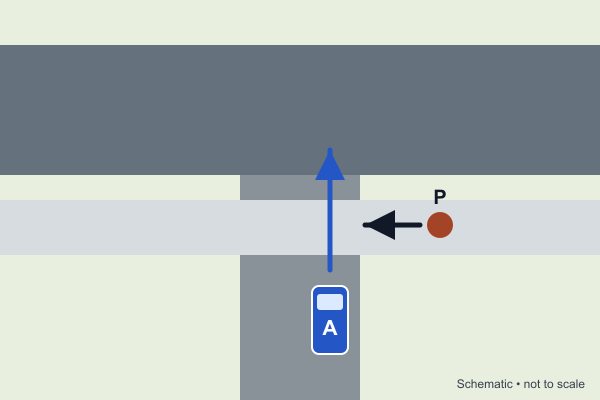
Car A is leaving a driveway across the sidewalk while pedestrian P approaches. What should A do?
- A. Stop and let P pass before crossing the sidewalk
- B. Drive on the sidewalk around P
- C. Assume the driveway gives A priority
- D. Pull across the sidewalk to make P stop
Show answer
Answer: A. Stop and let P pass before crossing the sidewalk
A driver leaving a driveway must give way to people on the sidewalk. The pedestrian path is shown in the diagram.
Question 14 · Speed & Following Distance
On a dry road in good conditions at 45 mph, what minimum following time does the handbook recommend?
- A. 2 seconds
- B. 1 second
- C. 4 seconds
- D. The same distance as a parked car
Show answer
Answer: C. 4 seconds
Above 30 mph, maintain at least four seconds under good conditions and more when conditions worsen.
Question 15 · Teen License Rules
A driver under 18 wants to make a hands-free social call while driving. No emergency exists. What is correct?
- A. The under-18 restriction also covers hands-free wireless use
- B. Calls are permitted below 30 mph
- C. Hands-free use is always permitted to minors
- D. Only texting is restricted for minors
Show answer
Answer: A. The under-18 restriction also covers hands-free wireless use
Texas restricts wireless communication device use by drivers under 18, including hands-free use, except emergencies.
Question 16 · Parking
You park facing downhill beside a curb. Which way should you turn the front wheels?
- A. Straight ahead in every case
- B. Toward the curb
- C. Away from the curb
- D. Toward the center of the road
Show answer
Answer: B. Toward the curb
Turn downhill wheels toward the curb and set the parking brake so a rolling vehicle is directed away from moving traffic.
Question 17 · Signaling, Passing & Turning
You want to change lanes on a multilane road. Which sequence is safest?
- A. Check mirrors and blind spot, signal, and move only into a safe gap
- B. Signal and move immediately
- C. Look only in the inside mirror
- D. Rely on another driver's horn to reveal a vehicle
Show answer
Answer: A. Check mirrors and blind spot, signal, and move only into a safe gap
Mirrors have blind spots. A signal does not reserve a lane or replace a direct check.
Question 18 · Crashes, Insurance & Safety Belts
An officer lawfully asks for evidence of financial responsibility during a traffic stop. What should you do?
- A. Say insurance is needed only after a crash
- B. Show only a fuel receipt
- C. Provide acceptable evidence of coverage or another lawful form of financial responsibility
- D. Explain that careful drivers need no evidence
Show answer
Answer: C. Provide acceptable evidence of coverage or another lawful form of financial responsibility
Texas requires financial responsibility and acceptable evidence. Insurance is the most common method, but other legally authorized methods exist.
Question 19 · Night, Weather & Hazards
Dense fog cuts how far ahead you can see. Which lighting and speed choice is best?
- A. Parking lights and increased speed
- B. No lights so reflections disappear
- C. High beams and normal speed
- D. Low beams and a reduced speed suited to visibility
Show answer
Answer: D. Low beams and a reduced speed suited to visibility
Low beams reflect less glare back in fog. Slow down, leave more space, and make sure you could stop within the stretch of road you can see.
Question 20 · Highway Driving
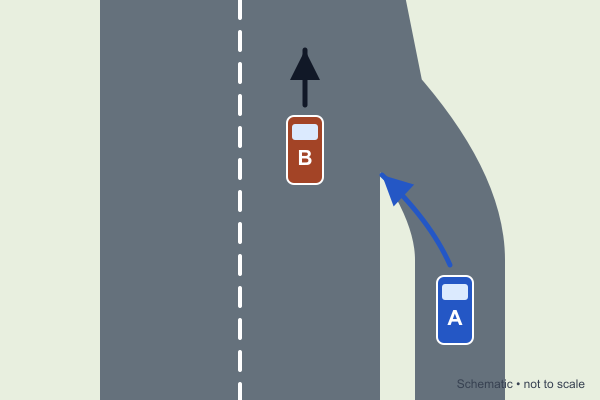
Car A is in the acceleration lane, and car B is on the highway. What is A's responsibility?
- A. Yield and merge into a safe gap
- B. Enter with no speed or mirror check
- C. Force B to stop
- D. Stop on the highway lane to join traffic
Show answer
Answer: A. Yield and merge into a safe gap
A is entering, so it gives way to through traffic and uses the acceleration lane to set up a safe merge.
Ready to test yourself?
Take a 30-question practice exam with the answers hidden. You get a score (pass with 21 of 30) and an explanation for every answer. For the real DPS exam, see about the permit test.
More free practice and lessons
- Free Texas DMV practice test
- Road signs practice test
- Texas DMV Practice Mock Exam 1 with answers
- Texas DMV Practice Mock Exam 2 with answers
- Texas DMV Practice Mock Exam 3 with answers
- Texas DMV Practice Mock Exam 4 with answers
- Texas DMV Practice Mock Exam 5 with answers
- Texas DMV Practice Mock Exam 6 with answers
- Texas DMV Practice Mock Exam 7 with answers
- Road signs by shape and color
- Right-of-way rules
- Numbers worth memorizing
- Texas rules for teen drivers
- About the Texas knowledge exam
- 7-day study plan
- Study tips