Texas DMV Practice Mock Exam 6
All 30 questions from Mock Exam 6, with answers and explanations.
A mixed exam: 6 sign questions, 4 road diagrams and 20 questions on the rules of the road, including sharing the road, parking and crashes, insurance & safety belts.
These are the 30 questions from Mock Exam 6, original practice questions on signs and the rules of the road, checked against the Texas Driver Handbook. Read through them with Show answer, or take the exam online first with the answers hidden and see your score. No sign-in needed.
These are original practice questions, not actual DPS exam questions. Each links to the Texas Driver Handbook (DL-7) so you can check the rule. Questions were last reviewed in November 2026; read how we write and check them.
Question 1 · Signaling, Passing & Turning
Your mirror shows an open lane, but you have not checked the blind spot. What should you do before moving over?
- A. Look only in the inside mirror
- B. Check mirrors and blind spot, signal, and move only into a safe gap
- C. Signal and move immediately
- D. Rely on another driver's horn to reveal a vehicle
Show answer
Answer: B. Check mirrors and blind spot, signal, and move only into a safe gap
Mirrors have blind spots. A signal does not reserve a lane or replace a direct check.
Question 2 · Crashes, Insurance & Safety Belts
You damage an empty parked pickup and cannot locate its owner. What should you do?
- A. Leave the required identifying information securely and fulfill applicable reporting duties
- B. Wait briefly and then drive away without information
- C. Leave because nobody saw it
- D. Leave only a note saying sorry
Show answer
Answer: A. Leave the required identifying information securely and fulfill applicable reporting duties
Hitting an unattended vehicle still creates duties. Look for the owner, or leave your written details where they will be found.
Question 3 · Parking
A parking space is on the approach to an intersection crosswalk. What clearance must you leave?
- A. 5 feet
- B. 20 feet
- C. 10 feet
- D. 12 feet
Show answer
Answer: B. 20 feet
Parking is banned closer than 20 feet to a crosswalk at a corner, because parked cars there hide people crossing.
Question 4 · Sharing the Road
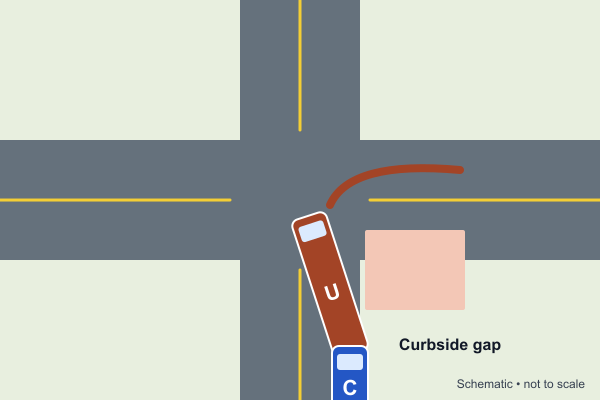
Truck U is making a wide right turn. Car C is behind it near the curb. What should C do?
- A. Stay behind and out of the curbside gap
- B. Assume the gap is a new traffic lane
- C. Pass between the truck and the curb
- D. Enter the gap beside the trailer
Show answer
Answer: A. Stay behind and out of the curbside gap
The rear wheels track inside the truck's front path. The curbside gap can close during the turn.
Question 5 · Speed & Following Distance
You travel at 20 mph in good dry conditions. What minimum following interval does the handbook give?
- A. Half a second
- B. 1 second
- C. No gap if traffic is light
- D. 2 seconds
Show answer
Answer: D. 2 seconds
At 30 mph or less on a good road, two seconds is the minimum gap. New drivers do better with four seconds, and any driver should add time when conditions get worse.
Question 6 · Parking
Your car faces uphill in a curbside space. How should its front wheels be turned?
- A. Toward the sidewalk only if the engine is running
- B. Away from the curb
- C. Toward the curb
- D. Straight ahead
Show answer
Answer: B. Away from the curb
With a curb, turn uphill wheels away from it so the curb can help stop a backward roll. Set the parking brake.
Question 7 · Parking
You have no disability plate or placard and see an empty accessible space. May you park there?
- A. Yes, outside business hours
- B. Yes, for under five minutes
- C. Yes, if the engine stays on
- D. No, it remains reserved for authorized users
Show answer
Answer: D. No, it remains reserved for authorized users
An empty accessible space is not permission for an unauthorized vehicle to use it. Access aisles must also remain clear.
Question 8 · Road Signs
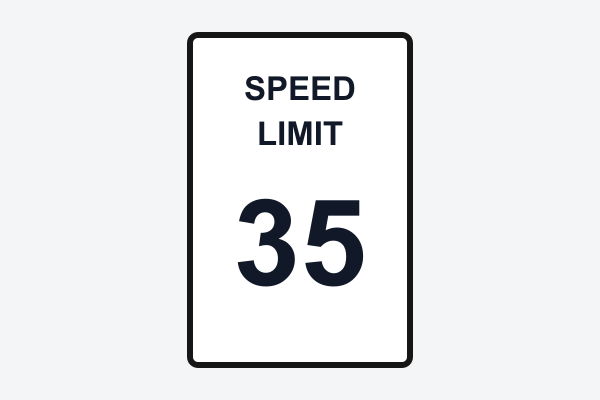
You see this sign as you approach the road ahead. What does the number on this white regulatory sign represent?
- A. The posted maximum under favorable conditions
- B. The road's route number
- C. A minimum speed for every vehicle
- D. A mandatory speed in all weather
Show answer
Answer: A. The posted maximum under favorable conditions
A speed limit sign sets a legal maximum; safe conditions may require slower travel.
Question 9 · Sharing the Road
You are beside a large truck and cannot see its driver in the mirror. What should you assume?
- A. You should stay beside the trailer
- B. You are probably in the driver's blind area
- C. The truck driver can always see your whole car
- D. Your horn gives you priority
Show answer
Answer: B. You are probably in the driver's blind area
Large vehicles have extensive blind spots. Avoid lingering beside or close behind them.
Question 10 · Road Signs
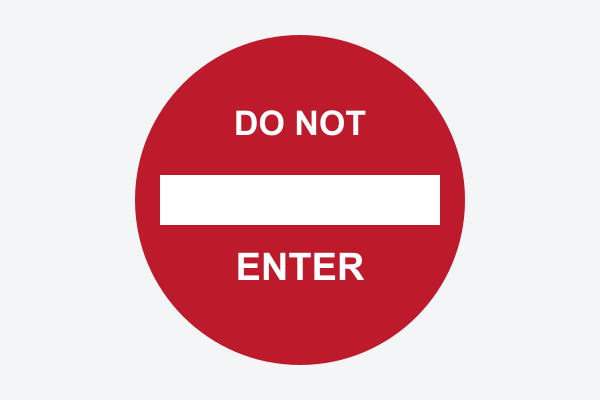
You see this sign as you approach the road ahead. What does this sign mean for the roadway immediately ahead?
- A. Enter only at low speed
- B. Enter if no police officer is present
- C. Only trucks may enter
- D. Do not enter from this direction
Show answer
Answer: D. Do not enter from this direction
Do Not Enter identifies a prohibited entrance, often the wrong end of a one-way road or exit ramp.
Question 11 · Traffic Signals
A signal at your approach flashes red after a power disruption. What basic control does it represent?
- A. As a signal only for cross traffic
- B. As an uninterrupted green signal
- C. As a warning to accelerate
- D. As a stop sign
Show answer
Answer: D. As a stop sign
A flashing red signal requires a stop, followed by yielding and proceeding when safe.
Question 12 · Crashes, Insurance & Safety Belts
What Texas minimum liability amounts apply per injured person, per injury crash, and for property damage?
- A. $10,000 / $20,000 / $5,000
- B. $30,000 / $60,000 / $25,000
- C. $50,000 / $50,000 / $5,000
- D. $25,000 / $25,000 / $10,000
Show answer
Answer: B. $30,000 / $60,000 / $25,000
The minimum liability amounts are commonly described as 30/60/25. This is a legal minimum rather than a recommendation that it covers every loss.
Question 13 · Night, Weather & Hazards
Fog thickens on an unlit road. Which combination of lighting and speed is best?
- A. Parking lights and increased speed
- B. Low beams and a reduced speed suited to visibility
- C. High beams and normal speed
- D. No lights so reflections disappear
Show answer
Answer: B. Low beams and a reduced speed suited to visibility
Low beams reflect less glare back in fog. Slow down, leave more space, and make sure you could stop within the stretch of road you can see.
Question 14 · Night, Weather & Hazards
A daytime storm limits clear sight of vehicles to 600 feet. What does the headlight rule require?
- A. Wait until visibility falls below 50 feet
- B. Turn on headlights because visibility is less than 1,000 feet
- C. Use only hazard lights while moving
- D. Use headlights only after sunset
Show answer
Answer: B. Turn on headlights because visibility is less than 1,000 feet
Headlights are required any time you cannot clearly make out people or vehicles 1,000 feet ahead, day or night.
Question 15 · Road Signs
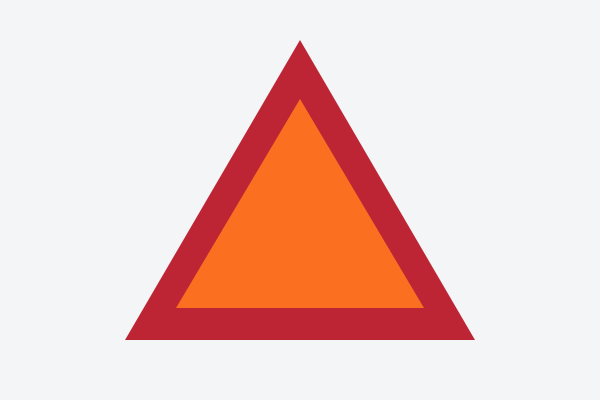
You see this sign as you approach the road ahead. What does this reflective triangular emblem identify?
- A. A vehicle with emergency priority
- B. A vehicle that must travel in the passing lane
- C. A hazardous-materials container in every case
- D. A slow-moving vehicle
Show answer
Answer: D. A slow-moving vehicle
The orange triangle with a red border marks vehicles built to travel no faster than 25 mph. Approach with care.
Question 16 · Road Signs
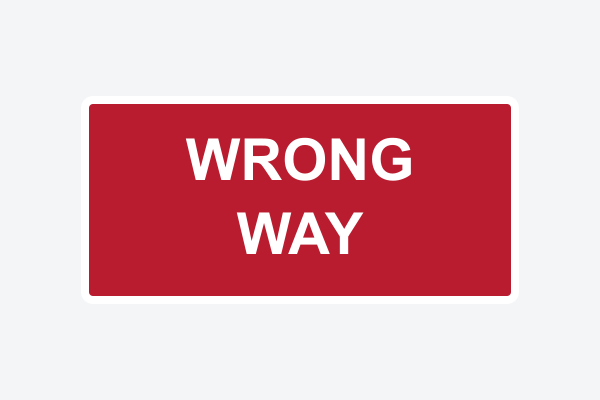
You turned onto a road and now see this sign facing you. What should you recognize?
- A. The sign warns only pedestrians
- B. You should speed up until the next exit
- C. The road is closed only to trucks
- D. You are traveling against the permitted direction and must correct safely
Show answer
Answer: D. You are traveling against the permitted direction and must correct safely
Wrong Way warns that you are moving against traffic. Avoid further exposure and correct the error safely.
Question 17 · Sharing the Road
The vehicle ahead stops at a pedestrian crossing, and you cannot see past it. What should you do?
- A. Do not pass the stopped vehicle to overtake at the crosswalk
- B. Honk and accelerate around it
- C. Pass if you see no one in your lane yet
- D. Pass on the shoulder without slowing
Show answer
Answer: A. Do not pass the stopped vehicle to overtake at the crosswalk
A stopped vehicle may conceal a pedestrian. Passing a vehicle stopped to allow a pedestrian to cross is prohibited.
Question 18 · Teen License Rules
A 17-year-old provisional driver plans a recreational trip at 2 a.m. with no applicable exception. What rule applies?
- A. The restriction ends at midnight
- B. The midnight-to-5-a.m. restriction prevents that trip
- C. The trip is allowed because roads are quiet
- D. The restriction applies only without passengers
Show answer
Answer: B. The midnight-to-5-a.m. restriction prevents that trip
Provisional drivers under 18 may not drive between midnight and 5 a.m. unless a stated exception applies.
Question 19 · Sharing the Road
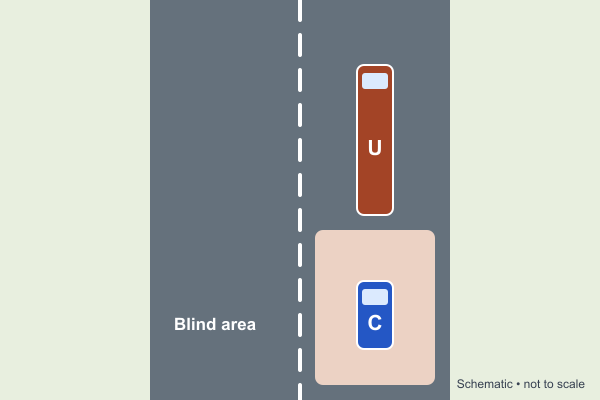
Car C is close behind truck U in the shaded blind area. What is the safer adjustment?
- A. Follow closer to reduce wind
- B. Stay hidden until the truck changes lanes
- C. Increase space so C is visible and has a better view
- D. Use the shoulder continuously
Show answer
Answer: C. Increase space so C is visible and has a better view
Moving out of a truck's blind area improves visibility and escape space. Do not tailgate a large vehicle.
Question 20 · Sharing the Road
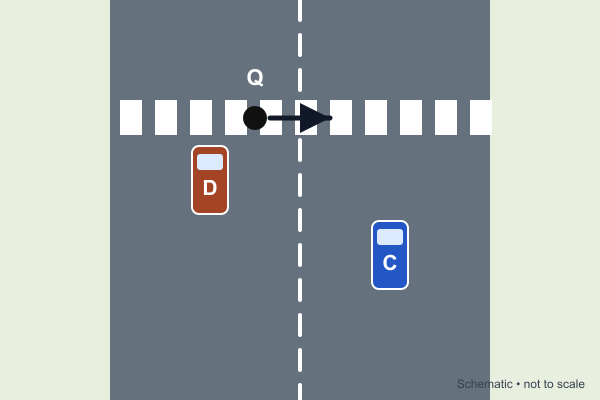
Car D is stopped for pedestrian Q in the crosswalk. C approaches in the adjacent lane. What should C do?
- A. Stop as needed and do not pass D to overtake at the crosswalk
- B. Pass D because Q has not entered C's lane yet
- C. Accelerate before Q arrives
- D. Drive around D on the sidewalk
Show answer
Answer: A. Stop as needed and do not pass D to overtake at the crosswalk
A stopped vehicle can hide a crossing pedestrian. Never overtake a vehicle stopped to let a pedestrian cross.
Question 21 · Alcohol, Drugs & Distractions
You have difficulty remembering the last few miles and keep yawning. What should you do?
- A. Drive faster to arrive sooner
- B. Follow another car closely to stay alert
- C. Open a window and continue indefinitely
- D. Stop at a safe place and rest
Show answer
Answer: D. Stop at a safe place and rest
Fatigue reduces attention and reaction ability. Rest is the proper response; noise or cold air does not replace sleep.
Question 22 · Crashes, Insurance & Safety Belts
An officer requests proof of financial responsibility after a lawful stop. What must you be able to present?
- A. Say insurance is needed only after a crash
- B. Explain that careful drivers need no evidence
- C. Show only a fuel receipt
- D. Provide acceptable evidence of coverage or another lawful form of financial responsibility
Show answer
Answer: D. Provide acceptable evidence of coverage or another lawful form of financial responsibility
Texas requires financial responsibility and acceptable evidence. Insurance is the most common method, but other legally authorized methods exist.
Question 23 · Parking
A curb space is beside a hydrant. What minimum distance must you leave?
- A. 5 feet
- B. 15 feet
- C. 3 feet
- D. 8 feet
Show answer
Answer: B. 15 feet
Hydrants need a 15-foot clear zone around them. Firefighters need access even when a space looks convenient.
Question 24 · Alcohol, Drugs & Distractions
Someone drinks alcohol after taking a sedating medicine. What risk should they recognize?
- A. The combined impairment may be greater and unpredictable
- B. The combination is safe if each amount is small
- C. The medicine cancels the alcohol
- D. Only illegal drugs can worsen alcohol effects
Show answer
Answer: A. The combined impairment may be greater and unpredictable
Alcohol and other drugs can interact and increase impairment. Avoid driving when affected.
Question 25 · Road Signs
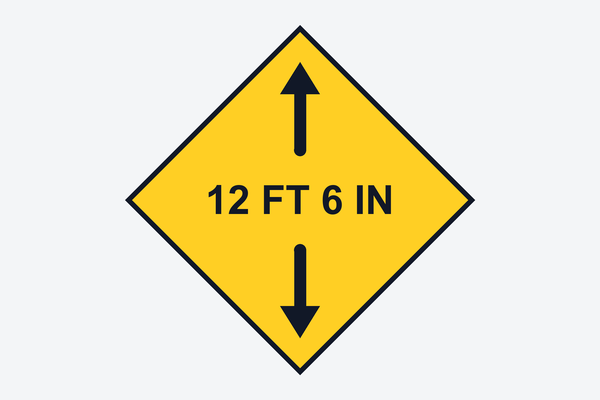
You drive a tall rental truck, and this sign shows less height than you need. What should you do?
- A. Drive through at higher speed
- B. Lower tire pressure and continue without checking
- C. Do not proceed beneath the obstruction; choose a suitable route
- D. Assume the number is only a speed suggestion
Show answer
Answer: C. Do not proceed beneath the obstruction; choose a suitable route
A low-clearance warning states available height. Know the vehicle's height and do not attempt an unsafe passage.
Question 26 · Night, Weather & Hazards
A vehicle approaches within 450 feet while your high beams are on. What should you do?
- A. Switch to low beams
- B. Turn off all lights
- C. Keep high beams on until it passes
- D. Flash high beams continuously
Show answer
Answer: A. Switch to low beams
Drop to low beams once oncoming traffic is closer than 500 feet, so you do not dazzle the other driver.
Question 27 · Traffic Signals
A yellow lamp blinks over your lane at an intersection. How should you approach?
- A. Assume all other traffic must stop
- B. Maintain speed without checking the intersection
- C. Ease off and cross with care
- D. Stop and wait until it turns green
Show answer
Answer: C. Ease off and cross with care
Flashing yellow warns you to use caution. It does not give you exclusive use of the intersection.
Question 28 · Right of Way
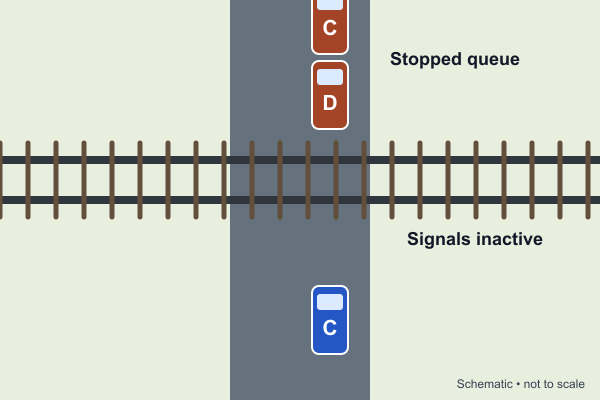
Traffic ahead is stopped, leaving too little room beyond the rails for car C. The crossing signals are not active. What should C do?
- A. Follow the next car without checking space
- B. Cross because no light is flashing
- C. Stop on the tracks behind the queue
- D. Wait before the tracks until the whole car can clear
Show answer
Answer: D. Wait before the tracks until the whole car can clear
Do not enter a rail crossing without room to clear it completely. Inactive signals are not a promise that a train will not arrive.
Question 29 · Right of Way
The red rail signals are flashing and the gate is lowering. What must an approaching driver do?
- A. Stop before the gate and wait
- B. Race across before the gate closes
- C. Stop on the first rail to look
- D. Drive around the gate if no train is visible
Show answer
Answer: A. Stop before the gate and wait
Never drive around or under a closing railroad gate. Cross only when signals and conditions permit.
Question 30 · Road Signs
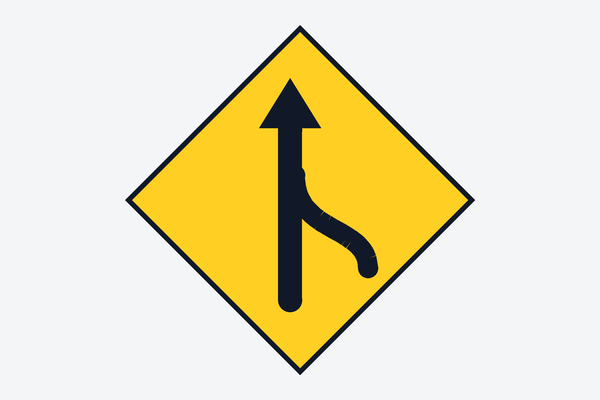
You see this sign as you approach the road ahead. What should you prepare for when you see this sign?
- A. Traffic joining the roadway ahead
- B. An immediate stop in every lane
- C. A mandatory U-turn
- D. A road ending at a wall
Show answer
Answer: A. Traffic joining the roadway ahead
A merging traffic sign warns of joining traffic. Adjust space and speed safely.
Ready to test yourself?
Take a 30-question practice exam with the answers hidden. You get a score (pass with 21 of 30) and an explanation for every answer. For the real DPS exam, see about the permit test.
More free practice and lessons
- Free Texas DMV practice test
- Road signs practice test
- Rules of the road practice test
- Texas DMV Practice Mock Exam 1 with answers
- Texas DMV Practice Mock Exam 2 with answers
- Texas DMV Practice Mock Exam 3 with answers
- Texas DMV Practice Mock Exam 4 with answers
- Texas DMV Practice Mock Exam 5 with answers
- Texas DMV Practice Mock Exam 7 with answers
- Road signs by shape and color
- Right-of-way rules
- Numbers worth memorizing
- Texas rules for teen drivers
- About the Texas knowledge exam
- 7-day study plan
- Study tips