Texas Road Signs Practice Test
Signs, traffic signals and pavement markings, with answers.
Traffic signs are a big part of the Texas knowledge exam. These free questions cover regulatory and warning signs, traffic lights and arrows, and pavement markings. Look at each sign, pick your answer, then tap Show answer to see the explanation. New to signs? Start with our road signs lesson.
These are original practice questions, not actual DPS exam questions. Each links to the Texas Driver Handbook (DL-7) so you can check the rule. Questions were last reviewed in November 2026; read how we write and check them.
Question 1 · Pavement Markings
Two solid white lines separate your lane from an adjacent lane. What should you do?
- A. Cross them whenever traffic is slow
- B. Stay in your current lane and do not cross them
- C. Use them as a two-way turn lane
- D. Drive between them
Show answer
Answer: B. Stay in your current lane and do not cross them
Double solid white lines prohibit crossing. Choose a legal place for a lane change.
Question 2 · Road Signs
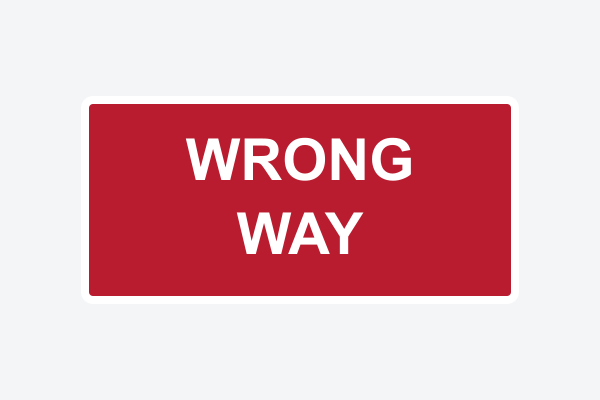
You face this sign after turning onto a roadway. What should you recognize?
- A. The road is closed only to trucks
- B. You are traveling against the permitted direction and must correct safely
- C. The sign warns only pedestrians
- D. You should speed up until the next exit
Show answer
Answer: B. You are traveling against the permitted direction and must correct safely
Wrong Way warns that you are moving against traffic. Avoid further exposure and correct the error safely.
Question 3 · Traffic Signals
A green left arrow is displayed for your lane. What should you still check?
- A. Whether the car behind is larger
- B. Pedestrians and vehicles still clearing the intersection
- C. Nothing because collisions are impossible on an arrow
- D. Only whether your radio is on
Show answer
Answer: B. Pedestrians and vehicles still clearing the intersection
A protected movement still requires attention to people and vehicles lawfully within the intersection.
Question 4 · Pavement Markings
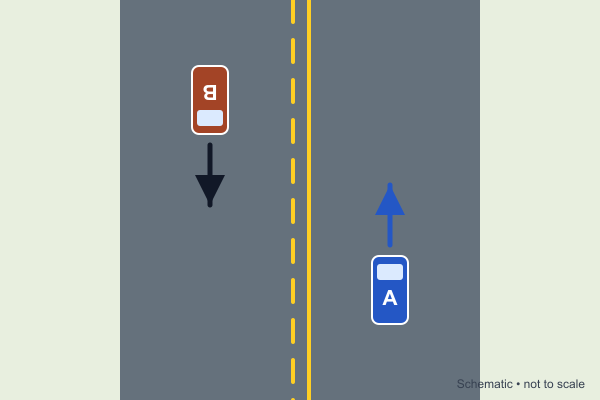
The center marking beside A is solid; the line beside B is broken. Which statement about passing across the center is correct?
- A. A may pass because B has a broken line
- B. Both may always pass
- C. Neither direction can ever pass anywhere on the road
- D. A may not cross the solid line to pass
Show answer
Answer: D. A may not cross the solid line to pass
The line closest to your lane decides whether you may pass. With a solid yellow line next to A, A may not cross it to pass.
Question 5 · Road Signs
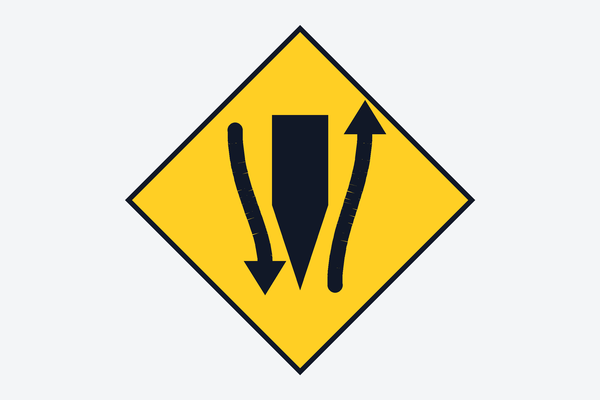
What roadway change does this symbol warn about?
- A. Opposing traffic will immediately share one lane
- B. A physical separation of opposing traffic begins
- C. A lane reserved only for motorcycles
- D. A bridge with a lower weight limit
Show answer
Answer: B. A physical separation of opposing traffic begins
The symbol warns of a divided highway beginning. Keep to the correct side of the divider.
Question 6 · Traffic Signals
A traffic signal is flashing yellow. What should you do?
- A. Stop and wait until it turns green
- B. Ease off and cross with care
- C. Assume all other traffic must stop
- D. Maintain speed without checking the intersection
Show answer
Answer: B. Ease off and cross with care
Flashing yellow warns you to use caution. It does not give you exclusive use of the intersection.
Question 7 · Pavement Markings
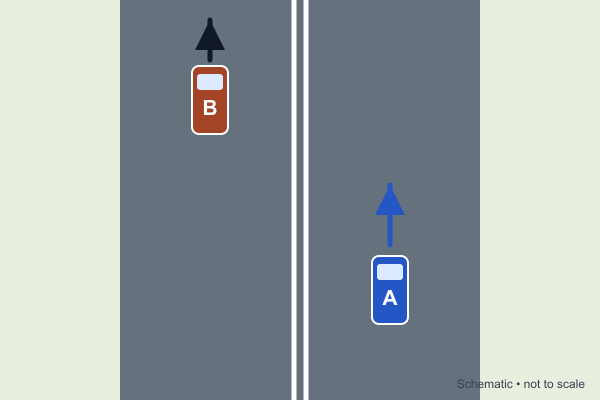
Car A wants to enter the adjacent lane across the two solid white lines shown. What should it do?
- A. Straddle both white lines
- B. Cross if the adjacent lane is faster
- C. Cross whenever its signal is on
- D. Wait for a legal crossing point
Show answer
Answer: D. Wait for a legal crossing point
Crossing double solid white lane markings is prohibited. A turn signal does not change that restriction.
Question 8 · Road Signs
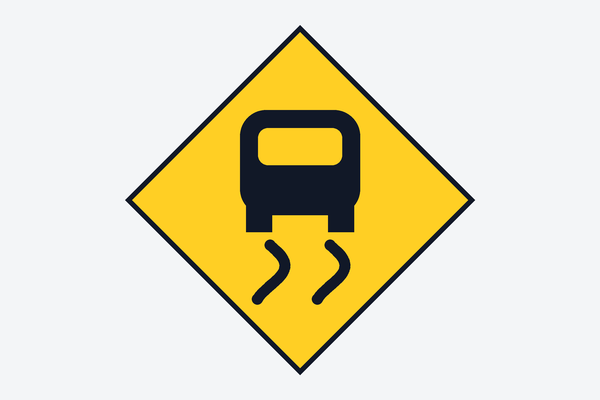
What risk does this warning symbol identify?
- A. Reduced traction when the roadway is wet
- B. A guarantee of flooding at every rain
- C. A mandatory lane change
- D. A road reserved for racing
Show answer
Answer: A. Reduced traction when the roadway is wet
The symbol warns that wet conditions can make the surface slippery. Use smooth controls and a suitable speed.
Question 9 · Traffic Signals
A traffic signal turns steady red as you approach the stop line. What is required?
- A. Roll forward until traffic clears
- B. Stop only if another vehicle is coming
- C. Treat the signal as a yield sign
- D. Stop before the stop line
Show answer
Answer: D. Stop before the stop line
A steady red signal requires a full stop. A later permitted turn requires yielding and compliance with any turn restriction.
Question 10 · Pavement Markings
A two-way road has a broken yellow centerline on your side. What does that line allow?
- A. Passing on a blind curve
- B. Passing when legal and safe with adequate sight distance
- C. Passing without checking opposing traffic
- D. Driving continuously in the opposing lane
Show answer
Answer: B. Passing when legal and safe with adequate sight distance
A dashed yellow line lets you cross to make a lawful pass, provided the way is clear. Sight distance and other limits still apply.
Question 11 · Road Signs
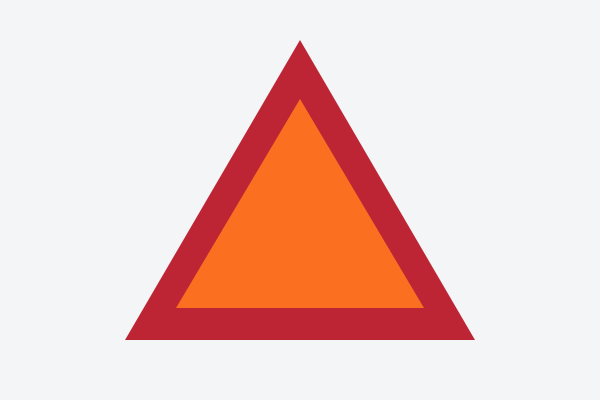
What does this reflective triangular emblem identify?
- A. A vehicle with emergency priority
- B. A slow-moving vehicle
- C. A vehicle that must travel in the passing lane
- D. A hazardous-materials container in every case
Show answer
Answer: B. A slow-moving vehicle
The orange triangle with a red border marks vehicles built to travel no faster than 25 mph. Approach with care.
Question 12 · Traffic Signals
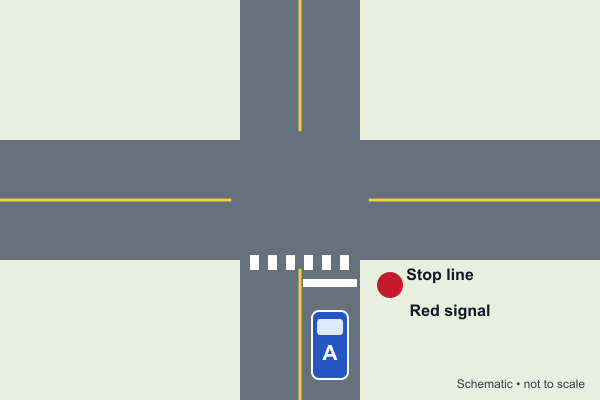
Car A approaches the red signal and marked stop line. Where must it stop?
- A. Beyond the crosswalk beside the signal
- B. In the center of the intersection
- C. On the crosswalk
- D. Behind the stop line
Show answer
Answer: D. Behind the stop line
The stop line marks the required stopping position. Keep the crosswalk clear.
Question 13 · Pavement Markings
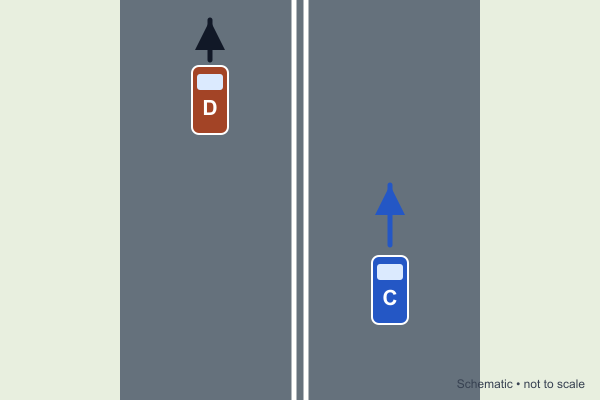
Car C wants to enter the adjacent lane across the two solid white lines shown. What should it do?
- A. Cross if the adjacent lane is faster
- B. Cross whenever its signal is on
- C. Wait for a legal crossing point
- D. Straddle both white lines
Show answer
Answer: C. Wait for a legal crossing point
Crossing double solid white lane markings is prohibited. A turn signal does not change that restriction.
Question 14 · Road Signs
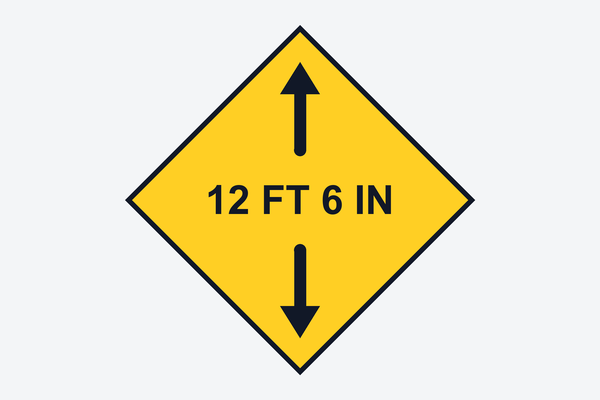
Your vehicle is taller than the clearance shown. What should you do?
- A. Lower tire pressure and continue without checking
- B. Do not proceed beneath the obstruction; choose a suitable route
- C. Assume the number is only a speed suggestion
- D. Drive through at higher speed
Show answer
Answer: B. Do not proceed beneath the obstruction; choose a suitable route
A low-clearance warning states available height. Know the vehicle's height and do not attempt an unsafe passage.
Question 15 · Traffic Signals
The light changes to steady yellow while you can still stop safely before the intersection. What is the appropriate action?
- A. Accelerate to beat the red light
- B. Stop safely
- C. Stop in the middle of the intersection
- D. Sound the horn and continue at any speed
Show answer
Answer: B. Stop safely
Yellow means red is next. Stop if you can do it safely.
Question 16 · Pavement Markings
Your exit lane is across two solid white lines. What should you do about changing lanes there?
- A. Use them as a two-way turn lane
- B. Drive between them
- C. Cross them whenever traffic is slow
- D. Stay in your current lane and do not cross them
Show answer
Answer: D. Stay in your current lane and do not cross them
Double solid white lines prohibit crossing. Choose a legal place for a lane change.
Question 17 · Road Signs
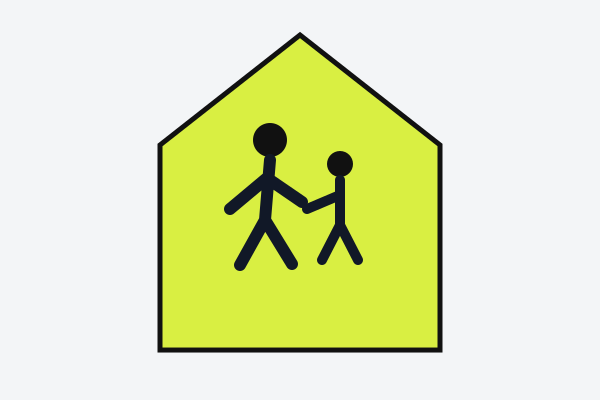
What area does this five-sided sign warn about?
- A. A railroad yard
- B. A school area or school crossing
- C. A hospital loading zone
- D. A truck-only intersection
Show answer
Answer: B. A school area or school crossing
Pentagon-shaped signs identify school areas and crossings. Watch carefully for children and obey posted controls.
Question 18 · Traffic Signals
After stopping at a steady red signal, you want to turn right. There is no sign prohibiting it. What else must you do?
- A. Wait for the driver behind to honk
- B. Yield to pedestrians and traffic before turning safely
- C. Enter the crosswalk to make pedestrians wait
- D. Turn immediately because you already stopped
Show answer
Answer: B. Yield to pedestrians and traffic before turning safely
A permitted right turn on red still requires a full stop and yielding. The absence of a prohibition does not make a gap safe.
Question 19 · Pavement Markings
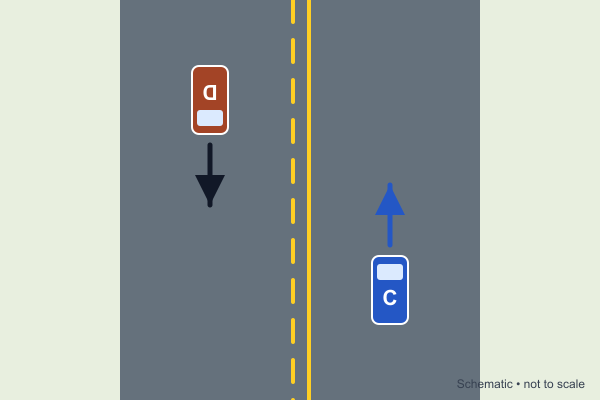
The center marking beside C is solid; the line beside D is broken. Which statement about passing across the center is correct?
- A. Neither direction can ever pass anywhere on the road
- B. C may pass because D has a broken line
- C. Both may always pass
- D. C may not cross the solid line to pass
Show answer
Answer: D. C may not cross the solid line to pass
The line closest to your lane decides whether you may pass. With a solid yellow line next to C, C may not cross it to pass.
Question 20 · Road Signs
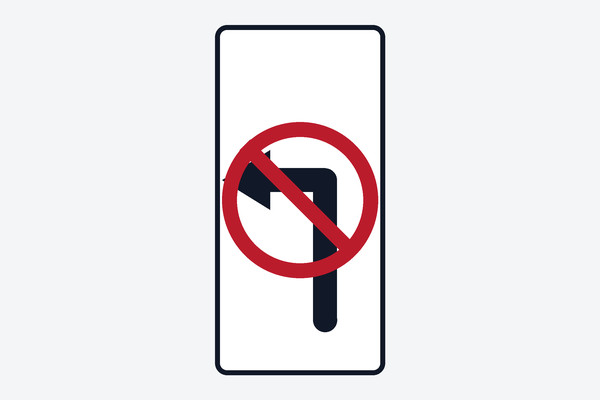
Which movement is prohibited by this sign?
- A. A mandatory U-turn
- B. A left turn
- C. A right turn
- D. All forward movement
Show answer
Answer: B. A left turn
The red circle and slash prohibit the illustrated left-turn movement.
Ready to test yourself?
Take a 30-question practice exam with the answers hidden. You get a score (pass with 21 of 30) and an explanation for every answer. For the real DPS exam, see about the permit test.
More free practice and lessons
- Free Texas DMV practice test
- Rules of the road practice test
- Texas DMV Practice Mock Exam 1 with answers
- Texas DMV Practice Mock Exam 2 with answers
- Texas DMV Practice Mock Exam 3 with answers
- Texas DMV Practice Mock Exam 4 with answers
- Texas DMV Practice Mock Exam 5 with answers
- Texas DMV Practice Mock Exam 6 with answers
- Texas DMV Practice Mock Exam 7 with answers
- Road signs by shape and color
- Right-of-way rules
- Numbers worth memorizing
- Texas rules for teen drivers
- About the Texas knowledge exam
- 7-day study plan
- Study tips