Texas DMV Practice Mock Exam 7
All 30 questions from Mock Exam 7, with answers and explanations.
A mixed exam: 6 sign questions, 4 road diagrams and 20 questions on the rules of the road, including signaling, passing & turning, right of way and crashes, insurance & safety belts.
These are the 30 questions from Mock Exam 7, original practice questions on signs and the rules of the road, checked against the Texas Driver Handbook. Read through them with Show answer, or take the exam online first with the answers hidden and see your score. No sign-in needed.
These are original practice questions, not actual DPS exam questions. Each links to the Texas Driver Handbook (DL-7) so you can check the rule. Questions were last reviewed in November 2026; read how we write and check them.
Question 1 · Road Signs
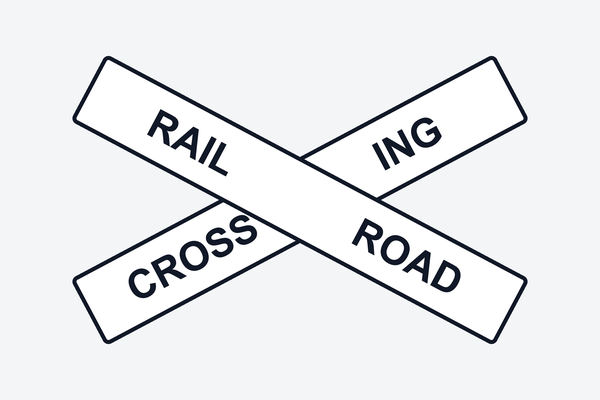
You see this sign as you approach the road ahead. What does this crossbuck mark?
- A. A road open only to rail workers
- B. A place to park clear of traffic
- C. A railroad crossing where you must yield to trains
- D. An intersection where cars outrank trains
Show answer
Answer: C. A railroad crossing where you must yield to trains
A crossbuck marks a rail crossing. Trains cannot yield like cars; check for trains and obey signals.
Question 2 · Traffic Signals
You face a green turn arrow, but a vehicle is still clearing the intersection. What should you check before moving?
- A. Only whether your radio is on
- B. Nothing because collisions are impossible on an arrow
- C. Whether the car behind is larger
- D. Pedestrians and vehicles still clearing the intersection
Show answer
Answer: D. Pedestrians and vehicles still clearing the intersection
A protected movement still requires attention to people and vehicles lawfully within the intersection.
Question 3 · Crashes, Insurance & Safety Belts
A rear-seat adult in a belt-equipped car is taking a short trip. What restraint is required?
- A. Belts are unnecessary below 40 mph
- B. The passenger must wear the safety belt
- C. Belts are required only in front
- D. Belts are optional on short trips
Show answer
Answer: B. The passenger must wear the safety belt
Texas safety belt requirements cover passengers in seats equipped with safety belts, including rear seats.
Question 4 · Pavement Markings
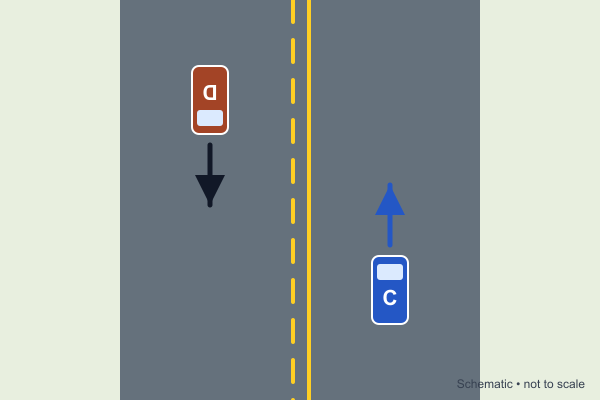
The center marking beside C is solid; the line beside D is broken. Which statement about passing across the center is correct?
- A. Neither direction can ever pass anywhere on the road
- B. C may pass because D has a broken line
- C. Both may always pass
- D. C may not cross the solid line to pass
Show answer
Answer: D. C may not cross the solid line to pass
The line closest to your lane decides whether you may pass. With a solid yellow line next to C, C may not cross it to pass.
Question 5 · Teen License Rules
A 17-year-old wants a hands-free chat while driving, with no emergency. What is correct?
- A. Calls are permitted below 30 mph
- B. Only texting is restricted for minors
- C. The under-18 restriction also covers hands-free wireless use
- D. Hands-free use is always permitted to minors
Show answer
Answer: C. The under-18 restriction also covers hands-free wireless use
Texas restricts wireless communication device use by drivers under 18, including hands-free use, except emergencies.
Question 6 · Right of Way
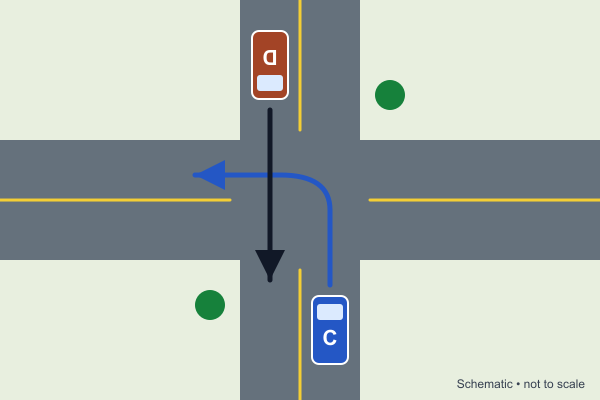
Car C is turning left across car D's straight path. Both face green signals without arrows. What should C do?
- A. Turn first because C is shown lower on the picture
- B. Block D until it stops
- C. Yield to D and wait for a safe gap
- D. Turn because signaling gives priority
Show answer
Answer: C. Yield to D and wait for a safe gap
An unprotected left turn yields to approaching traffic. Diagram position is not a source of priority.
Question 7 · Speed & Following Distance
You follow another vehicle at 50 mph on a dry clear road. What minimum time gap is recommended?
- A. 1 second
- B. The same distance as a parked car
- C. 2 seconds
- D. 4 seconds
Show answer
Answer: D. 4 seconds
Above 30 mph, maintain at least four seconds under good conditions and more when conditions worsen.
Question 8 · Signaling, Passing & Turning
A pickup begins overtaking your car on a two-way road. What should you do with your speed and position?
- A. Keep right and avoid increasing speed
- B. Speed up to shorten the passing gap
- C. Move left to discourage the pass
- D. Brake sharply without a hazard ahead
Show answer
Answer: A. Keep right and avoid increasing speed
Do not increase speed while being passed. Maintain safe positioning and help the pass finish safely.
Question 9 · Right of Way
A raised median separates you from an opposite-direction school bus displaying its red stop lamps. How does the exception apply?
- A. You need not stop solely for that bus but must remain alert
- B. You may ignore pedestrians on your roadway
- C. Every vehicle on every roadway must stop
- D. The exception also applies to a painted center turn lane
Show answer
Answer: A. You need not stop solely for that bus but must remain alert
A driver on a separate roadway need not stop for the bus across the physical separation. A painted median or turn lane does not create that exception.
Question 10 · Crashes, Insurance & Safety Belts
A child age 6 is 4 feet 5 inches tall. What restraint is required?
- A. A seat belt only because the child is over 6
- B. A properly fitted, approved child car seat
- C. An adult lap belt alone in every case
- D. No restraint in the rear seat
Show answer
Answer: B. A properly fitted, approved child car seat
A child younger than 8 must use an appropriate child passenger safety seat unless taller than 4 feet 9 inches. Follow the system's instructions.
Question 11 · Right of Way
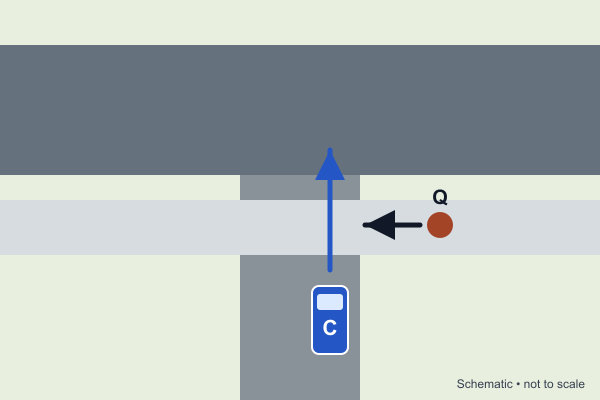
Car C is leaving a driveway across the sidewalk while pedestrian Q approaches. What should C do?
- A. Drive on the sidewalk around Q
- B. Stop and let Q pass before crossing the sidewalk
- C. Assume the driveway gives C priority
- D. Pull across the sidewalk to make Q stop
Show answer
Answer: B. Stop and let Q pass before crossing the sidewalk
A driver leaving a driveway must give way to people on the sidewalk. The pedestrian path is shown in the diagram.
Question 12 · Road Signs
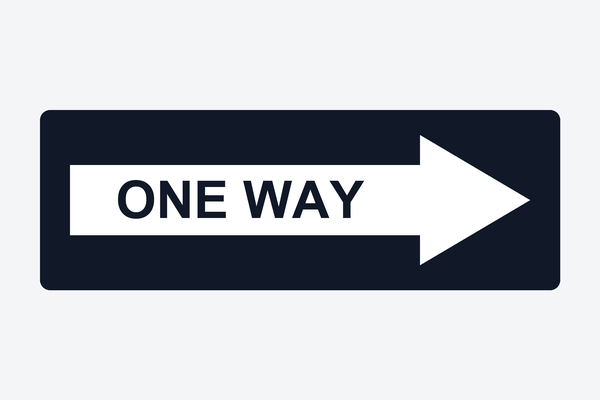
You see this sign as you approach the road ahead. What does this sign establish?
- A. The arrow marks a scenic detour
- B. Traffic may use either direction
- C. Only the left lane is open
- D. Traffic travels only in the arrow's direction
Show answer
Answer: D. Traffic travels only in the arrow's direction
A One Way sign defines the lawful direction of traffic on that road.
Question 13 · Right of Way
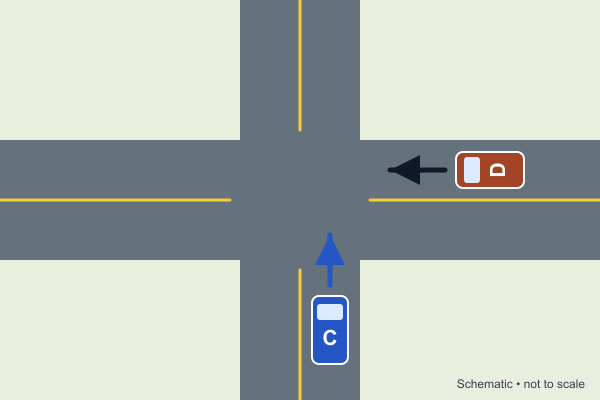
Cars C and D reach this uncontrolled intersection simultaneously. C is the blue car, and D is on C's right. Who should yield?
- A. C yields to D
- B. Both must accelerate
- C. D always yields to C
- D. The wider vehicle goes first
Show answer
Answer: A. C yields to D
When two cars arrive together with no controls, the car on the right goes first. The diagram fixes the relative positions.
Question 14 · Signaling, Passing & Turning
Your destination's driveway appears too late for a safe turn. What is the best next action?
- A. Brake hard and reverse in the lane
- B. Continue to a safe legal place to change route
- C. Make a sudden turn from the wrong lane
- D. Cut across several lanes immediately
Show answer
Answer: B. Continue to a safe legal place to change route
A missed turn is less dangerous than an abrupt maneuver. Continue and reroute safely.
Question 15 · Road Signs
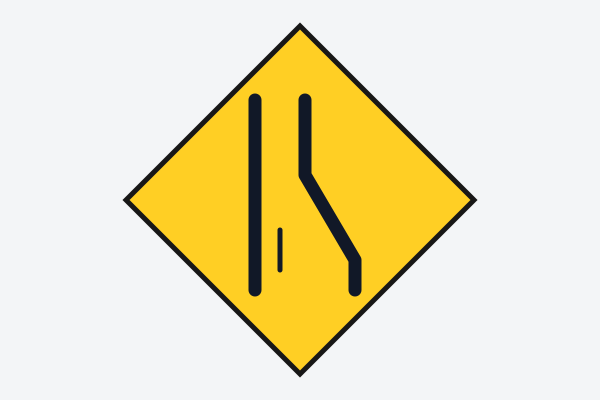
You see this sign as you approach the road ahead. What does this warning require you to anticipate?
- A. A right-of-way over every other driver
- B. A new lane that never ends
- C. A compulsory stop at the sign
- D. A lane ending and the need to merge safely
Show answer
Answer: D. A lane ending and the need to merge safely
Lane reduction warnings allow time to find a safe gap. A warning sign does not grant merging priority.
Question 16 · Road Signs
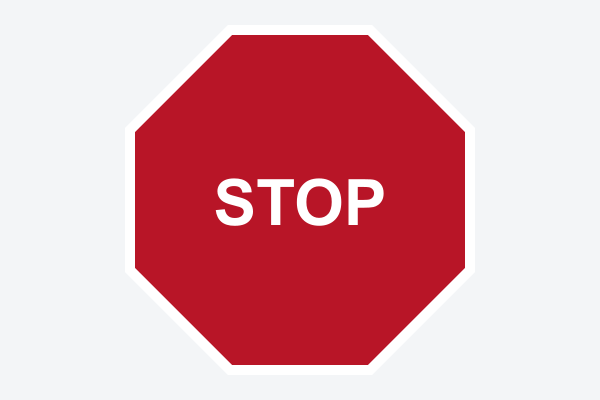
You see this sign as you approach the road ahead. What action does the pictured sign require?
- A. Stop only when another car is visible
- B. Stop fully, then go when the way is clear
- C. Continue because the sign is a warning
- D. Slow down without stopping
Show answer
Answer: B. Stop fully, then go when the way is clear
The octagonal red stop sign requires a complete stop at the proper stopping position, then yielding before entry.
Question 17 · Traffic Signals
Your signal changes to yellow while you are far enough away for a normal safe stop. What should you do?
- A. Stop in the middle of the intersection
- B. Stop safely
- C. Accelerate to beat the red light
- D. Sound the horn and continue at any speed
Show answer
Answer: B. Stop safely
Yellow means red is next. Stop if you can do it safely.
Question 18 · Highway Driving
You are on an entrance ramp with moving freeway traffic alongside. What is your merging responsibility?
- A. Enter without checking the lane beside you
- B. Force through traffic to brake for you
- C. Stop at the end of every ramp even with a clear gap
- D. Use the acceleration lane and yield while finding a safe gap
Show answer
Answer: D. Use the acceleration lane and yield while finding a safe gap
Build up to the speed of traffic where it is safe, and give way to cars on the highway. Do not assume they must make room.
Question 19 · Speed & Following Distance
Spray from a truck begins obscuring your view in rain. How should you adjust your following gap?
- A. Increase following time and reduce speed as needed
- B. Shorten the gap to see its taillights better
- C. Brake only after its brake lights go off
- D. Match its speed regardless of spray
Show answer
Answer: A. Increase following time and reduce speed as needed
Wet roads reduce traction and can increase stopping distance. Extra space allows smoother reactions.
Question 20 · Road Signs
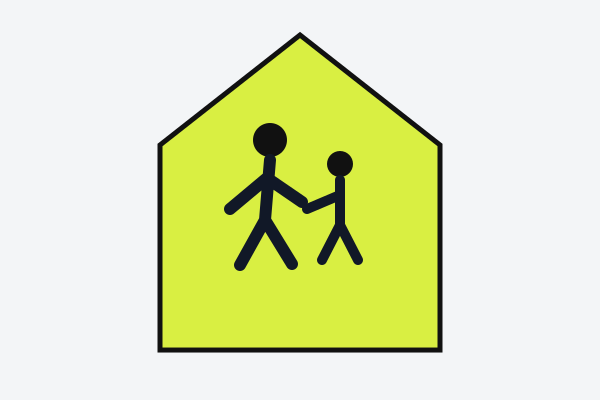
You see this sign as you approach the road ahead. What area does this five-sided sign warn about?
- A. A school area or school crossing
- B. A hospital loading zone
- C. A railroad yard
- D. A truck-only intersection
Show answer
Answer: A. A school area or school crossing
Pentagon-shaped signs identify school areas and crossings. Watch carefully for children and obey posted controls.
Question 21 · Sharing the Road
A rider holds the left arm horizontally before a corner. What does that signal indicate?
- A. A stop only
- B. A right turn only
- C. Permission for you to pass closely
- D. A left turn
Show answer
Answer: D. A left turn
A left arm extended horizontally signals a left turn. Give the rider space to complete the movement.
Question 22 · Parking
You face downhill with a curb beside the car. Where should the front wheels point when parked?
- A. Away from the curb
- B. Toward the curb
- C. Straight ahead in every case
- D. Toward the center of the road
Show answer
Answer: B. Toward the curb
Turn downhill wheels toward the curb and set the parking brake so a rolling vehicle is directed away from moving traffic.
Question 23 · Sharing the Road
A tractor-trailer is preparing a right turn and leaves room near the curb. What should you do?
- A. Assume the truck has abandoned the turn
- B. Pass on the right before it turns
- C. Drive into the gap and stop
- D. Stay back and avoid entering that gap
Show answer
Answer: D. Stay back and avoid entering that gap
Large trucks may need extra turning room. A vehicle entering the curbside gap can be trapped during the turn.
Question 24 · Night, Weather & Hazards
You feel the steering get light while crossing standing water. What is the best initial response?
- A. Ease off the accelerator and avoid abrupt braking or steering
- B. Accelerate to press the tires down
- C. Brake sharply and turn hard
- D. Apply the parking brake at once
Show answer
Answer: A. Ease off the accelerator and avoid abrupt braking or steering
Gradual speed reduction and smooth control help restore traction. Sudden inputs can make loss of control worse.
Question 25 · Signaling, Passing & Turning
A left-turning driver blocks your lane, and the only way around is a gravel shoulder. What should you do?
- A. Drive onto the sidewalk if empty
- B. Use the dirt shoulder at low speed
- C. Wait rather than drive off the pavement to pass
- D. Pass because the car has signaled
Show answer
Answer: C. Wait rather than drive off the pavement to pass
You may sometimes pass on the right, but never by driving off the pavement.
Question 26 · Alcohol, Drugs & Distractions
A person who drank says feeling relaxed proves the drive will be safe. What does that feeling establish?
- A. The driver is safe if confident
- B. The driver can compensate by opening a window
- C. Nothing; alcohol can impair judgment before the driver recognizes it
- D. The driver is safe on familiar roads
Show answer
Answer: C. Nothing; alcohol can impair judgment before the driver recognizes it
Alcohol affects judgment and coordination. Subjective confidence does not establish fitness to drive.
Question 27 · Road Signs
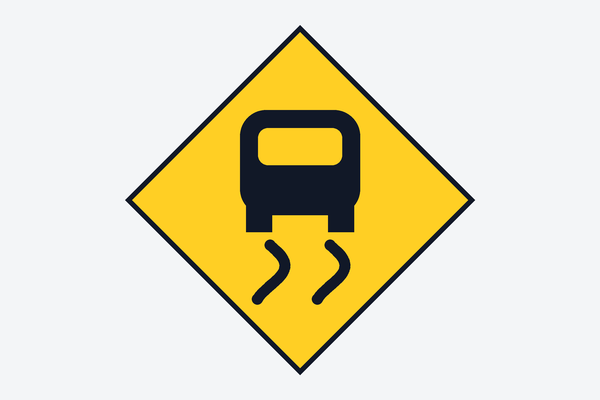
You see this sign as you approach the road ahead. What risk does this warning symbol identify?
- A. A road reserved for racing
- B. A mandatory lane change
- C. Reduced traction when the roadway is wet
- D. A guarantee of flooding at every rain
Show answer
Answer: C. Reduced traction when the roadway is wet
The symbol warns that wet conditions can make the surface slippery. Use smooth controls and a suitable speed.
Question 28 · Signaling, Passing & Turning
A driveway turn is 100 feet ahead on a public street. What is the minimum advance signaling distance?
- A. 10 feet
- B. Only while turning
- C. 100 feet
- D. 25 feet
Show answer
Answer: C. 100 feet
Turn on your signal 100 feet or more ahead of the turn, early enough to communicate without misleading other drivers.
Question 29 · Signaling, Passing & Turning
You are stopped waiting for a gap to turn left. Where should your front wheels point before you move?
- A. Straight ahead
- B. Pointing toward the opposite curb
- C. Already turned into oncoming traffic
- D. Turned fully right regardless of your path
Show answer
Answer: A. Straight ahead
Keeping wheels straight reduces the chance of being pushed into opposing traffic if struck from behind.
Question 30 · Teen License Rules
A provisional driver under 18 plans to carry two nonfamily passengers under 21 without an exception. Is that allowed?
- A. Yes, whenever it is daylight
- B. Yes, if everyone wears a belt
- C. Yes, if the trip is less than a mile
- D. No, a provisional driver may carry only one non-relative under 21
Show answer
Answer: D. No, a provisional driver may carry only one non-relative under 21
Texas provisional restrictions limit passengers under 21 who are not family members to one. Seat belts do not remove the restriction.
Ready to test yourself?
Take a 30-question practice exam with the answers hidden. You get a score (pass with 21 of 30) and an explanation for every answer. For the real DPS exam, see about the permit test.
More free practice and lessons
- Free Texas DMV practice test
- Road signs practice test
- Rules of the road practice test
- Texas DMV Practice Mock Exam 1 with answers
- Texas DMV Practice Mock Exam 2 with answers
- Texas DMV Practice Mock Exam 3 with answers
- Texas DMV Practice Mock Exam 4 with answers
- Texas DMV Practice Mock Exam 5 with answers
- Texas DMV Practice Mock Exam 6 with answers
- Road signs by shape and color
- Right-of-way rules
- Numbers worth memorizing
- Texas rules for teen drivers
- About the Texas knowledge exam
- 7-day study plan
- Study tips