Texas DMV Practice Mock Exam 5
All 30 questions from Mock Exam 5, with answers and explanations.
A mixed exam: 6 sign questions, 4 road diagrams and 20 questions on the rules of the road, including parking, right of way and alcohol, drugs & distractions.
These are the 30 questions from Mock Exam 5, original practice questions on signs and the rules of the road, checked against the Texas Driver Handbook. Read through them with Show answer, or take the exam online first with the answers hidden and see your score. No sign-in needed.
These are original practice questions, not actual DPS exam questions. Each links to the Texas Driver Handbook (DL-7) so you can check the rule. Questions were last reviewed in November 2026; read how we write and check them.
Question 1 · Teen License Rules
A Texas learner wants to practice on a public road. Who generally must supervise in the front passenger seat?
- A. Nobody if the trip is short
- B. Any licensed driver at least 16 years old
- C. A qualified licensed driver at least 21 years old
- D. Any friend with a learner license
Show answer
Answer: C. A qualified licensed driver at least 21 years old
Learner driving requires qualified supervision by a licensed driver age 21 or older in the front seat, subject to the license restrictions.
Question 2 · Right of Way
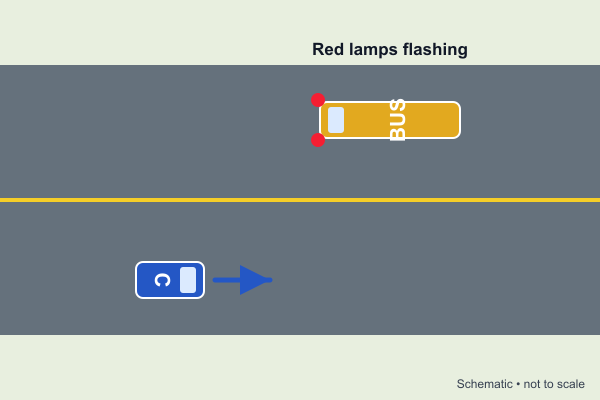
The bus shown is stopped with red lights flashing on this undivided road. Car C approaches in the opposing lane. What must C do?
- A. Continue because C is traveling the other way
- B. Pass if no child is drawn
- C. Stop for the bus
- D. Drive into the painted center area
Show answer
Answer: C. Stop for the bus
Opposing traffic must stop on an undivided road. The absence of a person in a diagram does not cancel the stop requirement.
Question 3 · Right of Way
A bus with red lights flashing is stopped across a two-lane road from you. There is only a painted centerline. What is required?
- A. Continue because the bus is across the centerline
- B. Pass slowly if no child is visible
- C. Stop only if the bus driver waves
- D. Stop until legally permitted to proceed
Show answer
Answer: D. Stop until legally permitted to proceed
Traffic in both directions stops for a school bus displaying its required stop signals on an undivided road. An ordinary centerline is not a physical separation.
Question 4 · Right of Way
A vehicle is circulating toward your roundabout entrance. Who must yield?
- A. Stop inside the circle to choose an exit
- B. Drive clockwise to shorten your route
- C. Yield to circulating traffic and enter a safe gap
- D. Enter first because arriving traffic has priority
Show answer
Answer: C. Yield to circulating traffic and enter a safe gap
Roundabout entrants yield to traffic already circulating. Follow lane markings and travel counterclockwise.
Question 5 · Parking
You find a space on the approach side of a yield sign. What minimum clearance applies?
- A. 15 feet
- B. 30 feet
- C. 5 feet
- D. 10 feet
Show answer
Answer: B. 30 feet
The handbook prohibits standing or parking within 30 feet on the approach to a stop sign, yield sign, flashing signal, or traffic control signal.
Question 6 · Alcohol, Drugs & Distractions
An 18-year-old drives with detectable alcohol below 0.08 BAC. Can a Texas alcohol-driving offense still apply?
- A. Alcohol rules do not apply to a learner license
- B. Zero tolerance applies only to drivers under 16
- C. Texas zero-tolerance rules can still apply
- D. Driving is always lawful below 0.08
Show answer
Answer: C. Texas zero-tolerance rules can still apply
A driver under 21 can violate Texas alcohol-driving rules with any detectable amount. The adult per se threshold is not permission for a minor to drink and drive.
Question 7 · Highway Driving
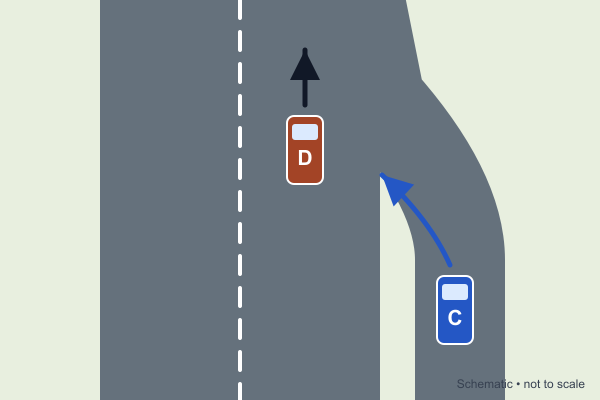
Car C is in the acceleration lane, and car D is on the highway. What is C's responsibility?
- A. Stop on the highway lane to join traffic
- B. Yield and merge into a safe gap
- C. Force D to stop
- D. Enter with no speed or mirror check
Show answer
Answer: B. Yield and merge into a safe gap
C is entering, so it gives way to through traffic and uses the acceleration lane to set up a safe merge.
Question 8 · Road Signs
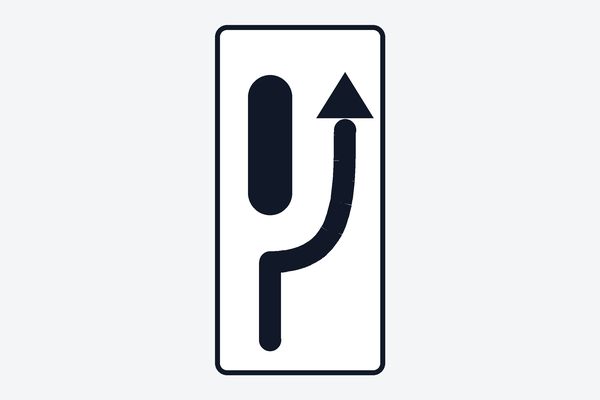
You see this sign as you approach the road ahead. How should you pass the obstruction indicated by this sign?
- A. Stop beside the sign until waved on
- B. Keep to its right
- C. Pass on either side at will
- D. Drive left of the obstruction
Show answer
Answer: B. Keep to its right
The sign directs traffic around an island or obstruction on the indicated side.
Question 9 · Crashes, Insurance & Safety Belts
You are a driver in a collision where a passenger is hurt. What duties apply?
- A. Move the injured person in every case
- B. Stop, summon appropriate help, and provide required information and reasonable aid
- C. Agree privately never to report it
- D. Leave if the other driver seems at fault
Show answer
Answer: B. Stop, summon appropriate help, and provide required information and reasonable aid
Drivers involved in an injury crash must stop and fulfill legal duties, including obtaining help and providing information. Avoid unnecessary movement of injured people.
Question 10 · Sharing the Road
You want to overtake a motorcycle in a narrow lane. How much lane use is the rider entitled to?
- A. No space if you drive a small car
- B. The full lane
- C. Only the right half of the lane
- D. Only enough for the width of its tires
Show answer
Answer: B. The full lane
A motorcycle has the same claim to a whole lane as a car. Do not squeeze in beside one when passing.
Question 11 · Pavement Markings
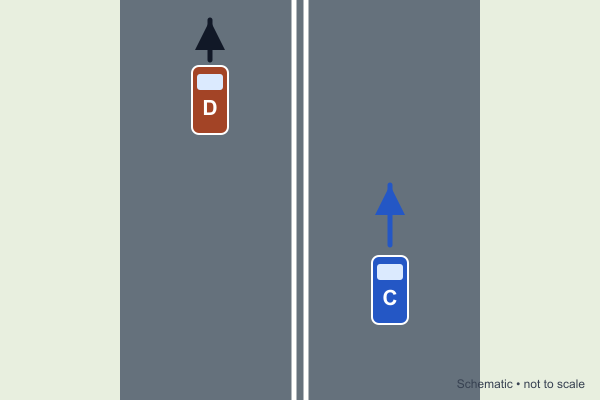
Car C wants to enter the adjacent lane across the two solid white lines shown. What should it do?
- A. Cross if the adjacent lane is faster
- B. Cross whenever its signal is on
- C. Wait for a legal crossing point
- D. Straddle both white lines
Show answer
Answer: C. Wait for a legal crossing point
Crossing double solid white lane markings is prohibited. A turn signal does not change that restriction.
Question 12 · Parking
An empty curb space lies near a rail crossing. What minimum distance from the nearest rail is required?
- A. At least 50 feet
- B. At least 15 feet
- C. At least 5 feet
- D. At least 10 feet
Show answer
Answer: A. At least 50 feet
Keep a parked car 50 feet or more from the closest rail, so it never blocks a crossing or a driver's view of a train.
Question 13 · Crashes, Insurance & Safety Belts
A property-damage-only crash leaves both cars drivable in traffic. What should their drivers do?
- A. Stand between the cars in moving traffic
- B. Keep the lane blocked until every detail is photographed
- C. Move to a suitable safe place and exchange required information
- D. Leave the scene without exchanging details
Show answer
Answer: C. Move to a suitable safe place and exchange required information
Move drivable vehicles out of traffic when safe in a property-damage crash, then fulfill information and reporting duties.
Question 14 · Night, Weather & Hazards
A sudden bang is followed by a strong pull as a tire fails. What should you do initially?
- A. Slam on the brakes immediately
- B. Hold the wheel firmly and gradually slow down
- C. Turn sharply onto the shoulder
- D. Release the steering wheel
Show answer
Answer: B. Hold the wheel firmly and gradually slow down
Keep control, ease off the accelerator, and slow gradually before moving to a safe stopping place.
Question 15 · Road Signs
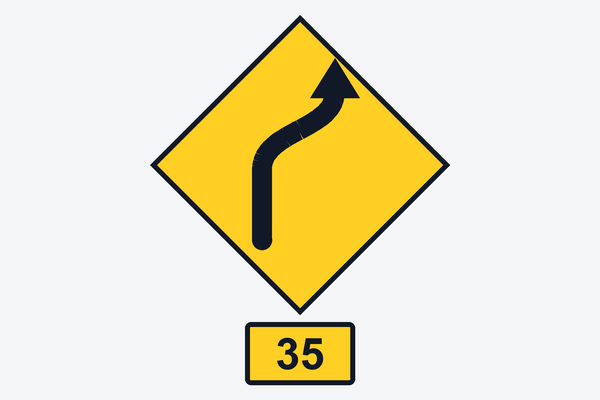
A smaller plaque sits under this curve warning. What does its number tell you?
- A. Permission to exceed a posted regulatory maximum
- B. The minimum speed you must maintain
- C. A guarantee that the curve is safe in ice
- D. A recommended speed for the curve under favorable conditions
Show answer
Answer: D. A recommended speed for the curve under favorable conditions
An advisory speed helps select a safe approach. Conditions may require slower speed and legal maximums still apply.
Question 16 · Speed & Following Distance
An alley has no sign changing its general speed rule. What maximum applies?
- A. 45 mph
- B. 15 mph
- C. 25 mph
- D. 30 mph
Show answer
Answer: B. 15 mph
The general maximum in an alley is 15 mph. Watch for people, driveways, and limited visibility.
Question 17 · Alcohol, Drugs & Distractions
Your phone displays an incoming message while the car is moving. When should you read it?
- A. Wait until safely parked to read it
- B. Hold the phone low to avoid distraction
- C. Read it while looking up between words
- D. Ask the driver behind to watch traffic for you
Show answer
Answer: A. Wait until safely parked to read it
Texas law generally bans reading, writing, or sending electronic messages at the wheel, with limited exceptions. Park safely before using the phone.
Question 18 · Pavement Markings
Your exit lane is across two solid white lines. What should you do about changing lanes there?
- A. Use them as a two-way turn lane
- B. Drive between them
- C. Cross them whenever traffic is slow
- D. Stay in your current lane and do not cross them
Show answer
Answer: D. Stay in your current lane and do not cross them
Double solid white lines prohibit crossing. Choose a legal place for a lane change.
Question 19 · Sharing the Road
A cyclist rides toward a red octagonal sign at an intersection. What basic traffic duty applies?
- A. The rider may ignore all traffic controls
- B. The rider must obey the stop sign
- C. Bicycles always have priority
- D. Only motor vehicles need to stop
Show answer
Answer: B. The rider must obey the stop sign
Bicycle riders on roads have traffic rights and duties and must obey applicable signs and signals.
Question 20 · Highway Driving
You see the exit sign only after passing the ramp. What should you do?
- A. Turn across the median
- B. Reverse along the shoulder
- C. Stop and back up in the right lane
- D. Continue to the next exit
Show answer
Answer: D. Continue to the next exit
Never back up on a freeway or cross its median to recover a missed exit. Continue to a safe legal route.
Question 21 · Night, Weather & Hazards
You close to 250 feet behind another car at night. Which beams should you use?
- A. Low beams
- B. High beams
- C. No lights if its taillights are visible
- D. Parking lights only
Show answer
Answer: A. Low beams
Use low beams when following within 300 feet. High beams can glare in the other driver's mirrors.
Question 22 · Speed & Following Distance
A police car with flashing lights is stopped beside your lane, and the next lane is safely open. What should you do?
- A. Accelerate past before it can pull out
- B. Change to the next lane over if you can do it safely
- C. Stay beside it and sound the horn
- D. Stop in the travel lane next to it
Show answer
Answer: B. Change to the next lane over if you can do it safely
For covered stopped vehicles, move out of the closest lane when possible on a multilane road. If unable to move safely, the required speed reduction applies.
Question 23 · Road Signs
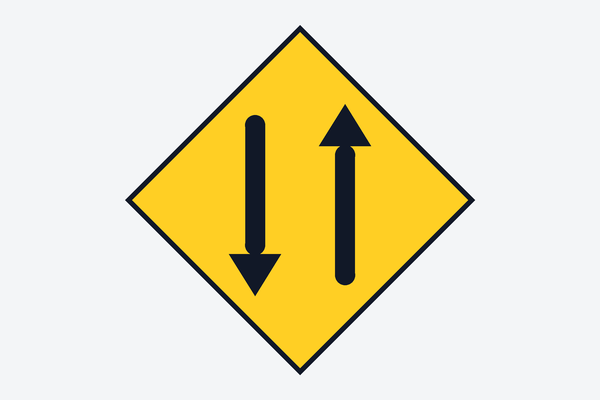
You see this sign as you approach the road ahead. What change does this sign announce?
- A. A parking area ahead
- B. Opposing traffic ahead
- C. Two lanes moving only in your direction
- D. An express lane with no oncoming vehicles
Show answer
Answer: B. Opposing traffic ahead
Opposing arrows warn that you are entering or approaching a two-way roadway.
Question 24 · Parking
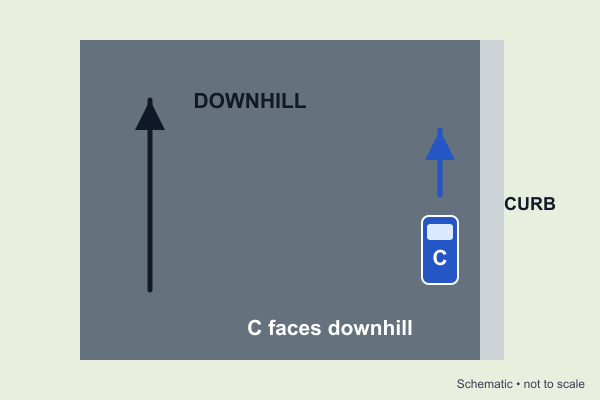
Car C is parked facing downhill beside the curb. Which wheel direction helps prevent a roll into traffic?
- A. Away from the curb
- B. Straight along the road in every situation
- C. Toward the curb
- D. Toward the centerline
Show answer
Answer: C. Toward the curb
Downhill parking calls for front wheels toward the curb, with the vehicle secured and parking brake set.
Question 25 · Road Signs
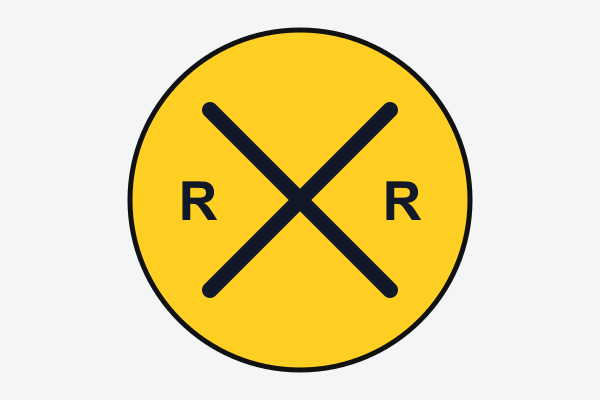
You see this sign as you approach the road ahead. What should you anticipate beyond this circular warning sign?
- A. A railroad crossing ahead
- B. A hospital entrance
- C. A mandatory right turn
- D. A roundabout that requires stopping
Show answer
Answer: A. A railroad crossing ahead
The round yellow railroad advance warning sign alerts you to tracks ahead. Be ready to obey crossing controls.
Question 26 · Road Signs
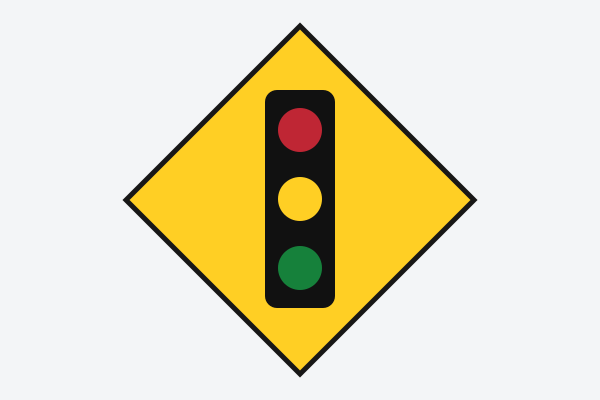
You see this sign as you approach the road ahead. What should you expect beyond this warning sign?
- A. A traffic signal ahead
- B. An uncontrolled passing zone
- C. A road ending without an intersection
- D. A railroad gate only
Show answer
Answer: A. A traffic signal ahead
Signal Ahead warns you to prepare for a controlled intersection, including a possible need to stop.
Question 27 · Signaling, Passing & Turning
You want to use a lane marked for opposing left-turn movements. Which purpose is appropriate?
- A. Use it as an extra freeway entrance lane
- B. Travel in it until your destination is close
- C. Pass several slow vehicles
- D. Prepare for a permitted left turn while watching for opposing users
Show answer
Answer: D. Prepare for a permitted left turn while watching for opposing users
A two-way left-turn lane is for turning movements, not through travel or passing. Drivers from both directions may use it.
Question 28 · Road Signs
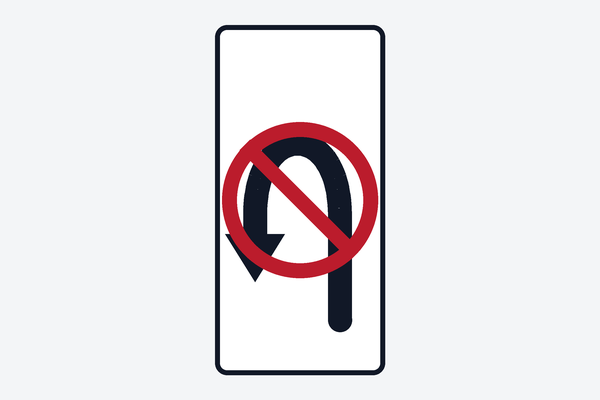
You see this sign as you approach the road ahead. Which maneuver is prohibited here?
- A. Every left turn at every intersection
- B. Turning right after yielding
- C. Turning around to travel in the opposite direction
- D. Stopping at a red light
Show answer
Answer: C. Turning around to travel in the opposite direction
The U-shaped arrow with a prohibition mark means no U-turn. Other movements depend on their own controls.
Question 29 · Parking
You finish parking and plan to walk away. How should you leave the vehicle?
- A. Engine off, parking brake on, key with you
- B. Rely entirely on the curb without securing it
- C. Leave the key for anyone who needs to move it
- D. Leave it idling in neutral
Show answer
Answer: A. Engine off, parking brake on, key with you
Secure the vehicle against movement and unauthorized use. Check for approaching traffic before opening a door.
Question 30 · Right of Way
You want to turn right on green while a pedestrian lawfully walks across your turning path. What should you do?
- A. Turn because green gives absolute priority
- B. Honk until the pedestrian stops
- C. Yield and let the pedestrian cross safely
- D. Pass in front of the pedestrian if you can fit
Show answer
Answer: C. Yield and let the pedestrian cross safely
A green signal does not remove the duty to yield to pedestrians lawfully crossing.
Ready to test yourself?
Take a 30-question practice exam with the answers hidden. You get a score (pass with 21 of 30) and an explanation for every answer. For the real DPS exam, see about the permit test.
More free practice and lessons
- Free Texas DMV practice test
- Road signs practice test
- Rules of the road practice test
- Texas DMV Practice Mock Exam 1 with answers
- Texas DMV Practice Mock Exam 2 with answers
- Texas DMV Practice Mock Exam 3 with answers
- Texas DMV Practice Mock Exam 4 with answers
- Texas DMV Practice Mock Exam 6 with answers
- Texas DMV Practice Mock Exam 7 with answers
- Road signs by shape and color
- Right-of-way rules
- Numbers worth memorizing
- Texas rules for teen drivers
- About the Texas knowledge exam
- 7-day study plan
- Study tips